
The Swalesian Bugle
Totally Gourdgeous
home


Hello folks, yes, at long last, I've finally gotten around to making something of a photo-essay of my time teaching English in Peru. Once again, a huge thankyou to everyone who supported me with donations and encouragement. It was an amazing experience, one I'm still thinking about, and I definitel want to do more volunteering in the future. Not sure yet whether I'll go back to Umasbamba (it's a long way and hellishly expensive) or try something a little closer to home - maybe Timor Leste or Laos. This blog is adapted from the letters I wrote to my mother while I was in Peru....
11th November 2008
Umasbamba
My first week in Peru has been so overwhelming I don’t
know where to start. I started with a week of Spanish lessons, which went well
and extended the peninsular Spanish I already had, but I offended my
teacher when she asked my religion and I said I was agnostic "Es no famoso
en Peru!" she said sourly, but she was a good teacher nonetheless. I
started in on the second day distributing breakfast to homeless children. In
Cuzco, there's no official place for children to stay who's parents are caught
up in the justice system, on remand and waiting for trial, so they just live in
the police station. There's a single dingy room, full of smelly mattresses, and
I went in every morning with one or two other volunteers, to hand out a bread
roll, a piece of fruit and a cup of warm, thin gruel. Some days there wasn't
enough to go around, because there's been confusion about how many children
would be there. It varied from 15 to about 35. Many of these children go out to
work in the daytime, selling matches or shining shoes. When the parents have
been sentenced, depending on the outcome, they either go home (if the parents
have been released) or are sent to an orphanage. One kid had apparently been
there for 3 months, but most of them were only there for a few days. My, they
were sad little things. It was a bit of a heartbreaking gig, that one.
In the evenings, to get some practise before coming to the village, I went to the Biblioteca Quosco Maki, a community centre that runs free English classes for the urban poor and homeless and helped Nando, the main teacher there with the classes. It was a good setup because there were two other volunteers, one English and one American, and that meant we could model the sentences for the students and they could get some practise at dealing with our different accents. Most of htem want to get work dealing with tourists, so they're going to be dealing with all sorts. I really liked that place. The students were adults, mostly, and very keen to learn. I met some very cool people there, who I ended up hanging out with after class a bit. I also found myself a one-on-one practise partner through Maximo Nivel - a lovely woman, who helped me with Spanish in exchange for me helping her with English. I like Cuzco - it's very vibrant, colourful and chaotic. I can see why most volunteers prefer to work from there. There's support. Out here, well, it feels a bit isolated. The villagers are warm, but very shy and formal with me. I'm the only English speaker for about 50 km. That in itself feels a little daunting, though I'm sure I'll manage. Senorita Mery has reassured me again and again that it's very safe out here. Much more than the city. I dare say she's right.
I’m now in the village of Umasbamba and I taught my first class today. Officially, I start tomorrow, but the women in the village asked me if I would teach them as well as the kids. I was expecting this, but I wasn’t expecting what it was like. They are lovely women – all so weather-beaten that you would think they were in their fifties, but most of them are about the same age as me. They have never spoken English in their lives before. Their native language is Quechua, and they have varying fluency in Spanish, but English is a real strain for them. The consonants and vowels are an enormous challenge. Words like No and You come out as Noi and Yui, and “ts” and “th” are totally absent from their phonology and hard for them to learn. I saw phonetic flashcards when I was shopping for teaching aids in the states, and didn’t buy them because I thought they were just for little kids. I wish I’d known better.
 subsistence community – they grow all
their own food. The men farm and the women tend the animals and sell their
handcrafts and occasionally tourists will come to learn some weaving. Mery is
their benefactress. She is an educated Peruvian woman who runs a travel agency,
and Umasbamba is her pet project. She only brings a select few tourists there,
but it’s her agency that has sponsored the building an equipping of the
community centre in which I’m teaching, and I think she might also be involved
in the renovation of the mud-brick church which is currently going on.
subsistence community – they grow all
their own food. The men farm and the women tend the animals and sell their
handcrafts and occasionally tourists will come to learn some weaving. Mery is
their benefactress. She is an educated Peruvian woman who runs a travel agency,
and Umasbamba is her pet project. She only brings a select few tourists there,
but it’s her agency that has sponsored the building an equipping of the
community centre in which I’m teaching, and I think she might also be involved
in the renovation of the mud-brick church which is currently going on.
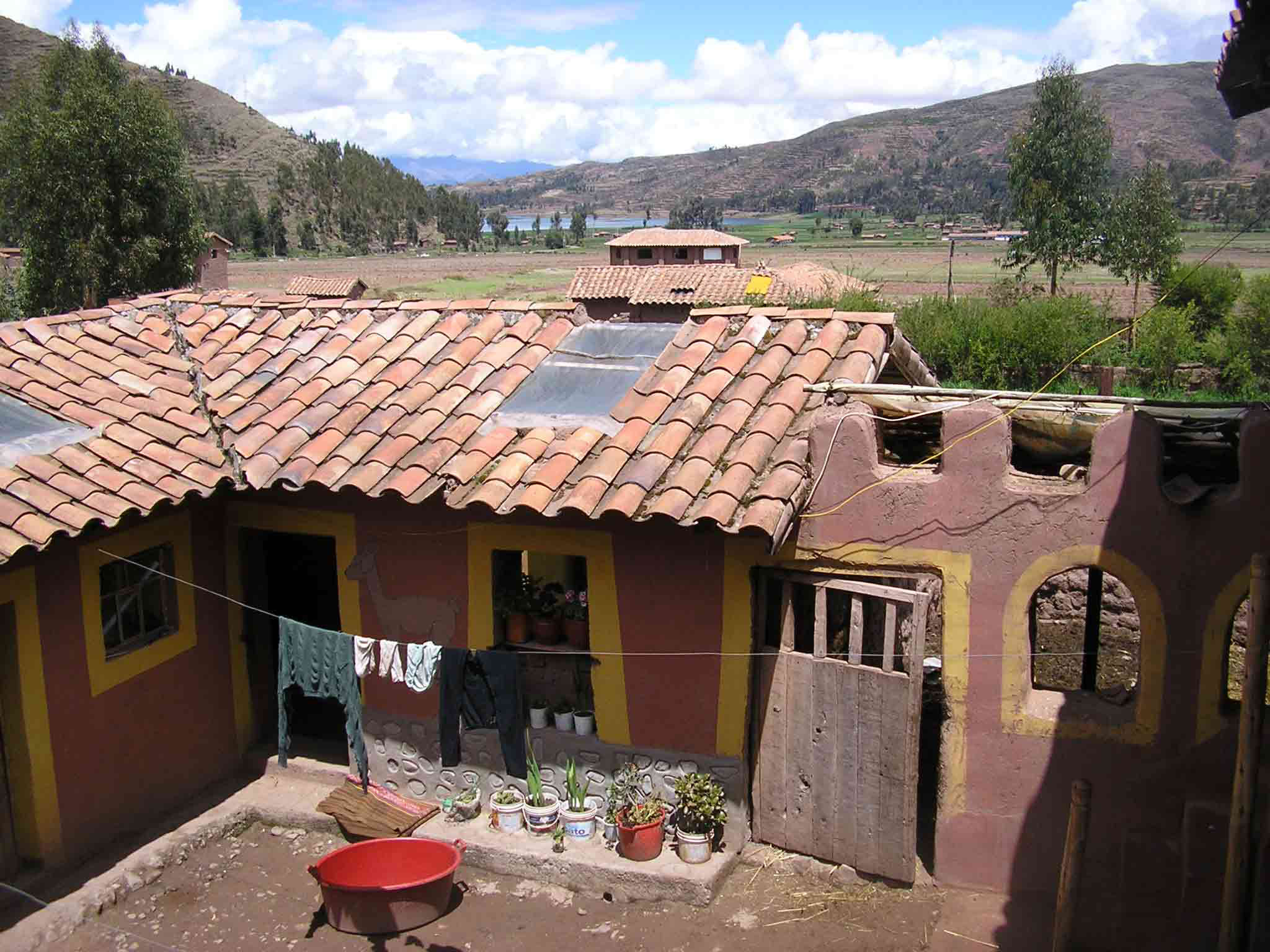
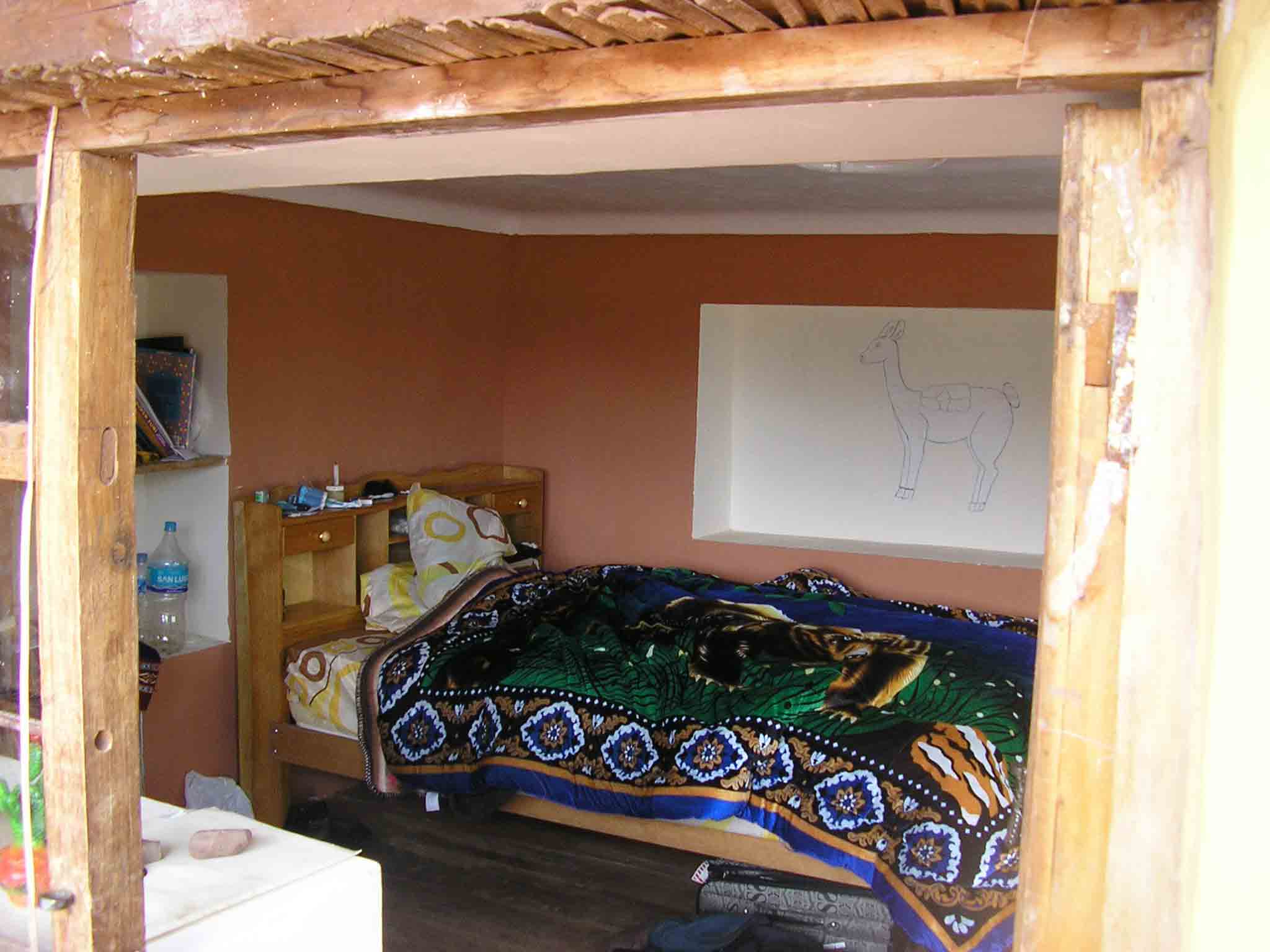
The house I am staying in is mud-brick, and luxurious by Village standards. It has electricity and a flush toilet. And I have my own room, which after sharing for a week in Cusco is a great boon. It’s probably the only luxury I really need. Most other things I can do without. The house is built around an earthen courtyard, which looks like it’s mud a lot of the time. The kitchen has a dirt floor, and is the home of several chickens and guinea pigs. All cooking is on an adobe hearth, the rooms are unheated. Margarita, my hostess, is extremely conscientious about my food, it’s been explained to her that all my water must be boiled and my gringa stomach must be treated with the utmost care. She mostly feeds me vegetable stew with an egg in it, boiled and boiled so that nothing has a hope of surviving. Actually, I think as gringas go, I’m in pretty good shape. All those years at Gembrook without a fridge and keeping chickens and growing my own food and burying my own poo means that I’ve got more intestinal flora than most whitefellas. I don’t fancy taking any chances, though, so I gratefully accept Margarita’s ministrations. She also plies me with herbals teas made form local plants, all which are pitched at strengthening my stomach and my chest, as she has noticed I have a cough still from the cold I had last week.
 One problem is that it’s hard to tell the women apart. They do all look very
similar. They’re all about four foot 10, with long black hair in braids,
identical hats, wearing full, grubby skirts with several petticoats and an
unidentified number of cardigans. Rafeala
is something of a leader in the town, and is easily identifiable because her hat
is blue while everyone else’s is brown. I don’t know if that’s a
coincidence or not, but she’s the leader of the Association of the Pure Virgin
that is restoring the church and she’s sharper than most. She’s the one who
seems to burn to improve Umasbamba. Certainly, it’s a pretty poor place in
material terms. Mostly just a huddle of mud huts and dirt roads surrounded by
fields that are all tilled by hand or with oxen or donkeys. Chickens, pigs,
dogs, all roam at will. Horses, donkeys and cows are mostly tied to stakes and
moved around daily.
One problem is that it’s hard to tell the women apart. They do all look very
similar. They’re all about four foot 10, with long black hair in braids,
identical hats, wearing full, grubby skirts with several petticoats and an
unidentified number of cardigans. Rafeala
is something of a leader in the town, and is easily identifiable because her hat
is blue while everyone else’s is brown. I don’t know if that’s a
coincidence or not, but she’s the leader of the Association of the Pure Virgin
that is restoring the church and she’s sharper than most. She’s the one who
seems to burn to improve Umasbamba. Certainly, it’s a pretty poor place in
material terms. Mostly just a huddle of mud huts and dirt roads surrounded by
fields that are all tilled by hand or with oxen or donkeys. Chickens, pigs,
dogs, all roam at will. Horses, donkeys and cows are mostly tied to stakes and
moved around daily.
My room has glass in the windows, but that’s a rarity. Little is done to try
and make the houses or the streets beautiful. There’s no flower gardens or
anything like that – though Margarita has a few pot plants in her tiny
compound. Some of the buildings have been painted in the distant past, but
it’s all flaked off now. The town square, which is very old, is surrounded by
a wall that has crucifixes and some triangular windows set into it for
decoration, but that’s about it. Actually, it’s possible that the triangular
windows are not decorative. They may date from the time when there was armed
conquest and the wall may have been a defensive ramparts and the holes there to
shoot through. Someone told me the church and the compound could be close to 500
years old. I went in the church the other day. It’s completely ruined inside,
just a mud floor. The men are thatching the roof with a kind of bamboo frame and
on top of that they will lay clay half-pipe tiles. Halfway up one wall was one
of those odd little pulpits that I’ve often seen in Europe, where the priest
goes up and preaches from a little circular balcony. You could see from that,
and that only, that the inside of the church was once very ornate. It has
intricate woodwork and faded gold leaf, but it’s only hanging on the wall by a
prayer. I’m kinda curious. It would seem that Umasbamba has had no church for
a very long time. Why they’d want one back is a mystery to me, but it’s a
big church. It can’t have been entirely accidental that it was allowed to
fall into such disrepair. Perhaps the locals reverted to their indigenous
try
and make the houses or the streets beautiful. There’s no flower gardens or
anything like that – though Margarita has a few pot plants in her tiny
compound. Some of the buildings have been painted in the distant past, but
it’s all flaked off now. The town square, which is very old, is surrounded by
a wall that has crucifixes and some triangular windows set into it for
decoration, but that’s about it. Actually, it’s possible that the triangular
windows are not decorative. They may date from the time when there was armed
conquest and the wall may have been a defensive ramparts and the holes there to
shoot through. Someone told me the church and the compound could be close to 500
years old. I went in the church the other day. It’s completely ruined inside,
just a mud floor. The men are thatching the roof with a kind of bamboo frame and
on top of that they will lay clay half-pipe tiles. Halfway up one wall was one
of those odd little pulpits that I’ve often seen in Europe, where the priest
goes up and preaches from a little circular balcony. You could see from that,
and that only, that the inside of the church was once very ornate. It has
intricate woodwork and faded gold leaf, but it’s only hanging on the wall by a
prayer. I’m kinda curious. It would seem that Umasbamba has had no church for
a very long time. Why they’d want one back is a mystery to me, but it’s a
big church. It can’t have been entirely accidental that it was allowed to
fall into such disrepair. Perhaps the locals reverted to their indigenous  religion for a time. There’s no blatant displays of religiosity that I’ve
seen. I’ve seen no-one say grace or pray or cross themselves or anything like
that. All I’ve really seen is these little crucifixes on some on the roofs,
usually accompanied by clay sculptures of a pair of oxen, and the kids have been
drawing Xmas-themes pictures in Julio’s class – they also read from
bible-themed books, and Hector showed me a bible stories book in Quechua.
religion for a time. There’s no blatant displays of religiosity that I’ve
seen. I’ve seen no-one say grace or pray or cross themselves or anything like
that. All I’ve really seen is these little crucifixes on some on the roofs,
usually accompanied by clay sculptures of a pair of oxen, and the kids have been
drawing Xmas-themes pictures in Julio’s class – they also read from
bible-themed books, and Hector showed me a bible stories book in Quechua.
Thursday 13 November
 The women from Maximo Nivel showed up at a good time. I was deeply frustrated
because only one woman had showed up to class this time. It turned out there was
some village celebration on – some equivalent of Father’s day, and they all
went to that. It was good to have some fluent bilingual speakers to voice my
frustration to. They were able to discover that there was a lot on this week,
not just socially but agriculturally, and the women are expected to turn out in
force from now on. I was also able to clear up a few minor misunderstandings.
Just as I was about to close the school and take the girls to Marga’s so they
could see for themselves that my living conditions were ok, women started
showing up. Ok, I thought, village time. I waited for you, now you wait for me.
I was grumpy because I’d put in hours of preparation and made them an alphabet
chart and planned a really thorough lesson. They seemed unperturbed and settled
in with their toddlers and their gossip.
The women from Maximo Nivel showed up at a good time. I was deeply frustrated
because only one woman had showed up to class this time. It turned out there was
some village celebration on – some equivalent of Father’s day, and they all
went to that. It was good to have some fluent bilingual speakers to voice my
frustration to. They were able to discover that there was a lot on this week,
not just socially but agriculturally, and the women are expected to turn out in
force from now on. I was also able to clear up a few minor misunderstandings.
Just as I was about to close the school and take the girls to Marga’s so they
could see for themselves that my living conditions were ok, women started
showing up. Ok, I thought, village time. I waited for you, now you wait for me.
I was grumpy because I’d put in hours of preparation and made them an alphabet
chart and planned a really thorough lesson. They seemed unperturbed and settled
in with their toddlers and their gossip.
 why, if it was
traditional for me not to hang out with men much, or if he had a problem with
me being there, or what. He and Margarita would be totally silent in my presence and
as soon as I excused myself and went to my room, I’d hear them laughing and
chatting – but it turned out to just be extreme shyness – indeed, all the
adults except Rafaela are extremely shy – and in the evening, the whole family
made a point of hanging out with me in the kitchen and it really helped me break
the ice. Margarita wants so badly to learn English. She’s frustrated with her own
slow progress, though and while she gets a lot of one-on-one coaching because
I’m in her house, it’s easy for her to get discouraged.
why, if it was
traditional for me not to hang out with men much, or if he had a problem with
me being there, or what. He and Margarita would be totally silent in my presence and
as soon as I excused myself and went to my room, I’d hear them laughing and
chatting – but it turned out to just be extreme shyness – indeed, all the
adults except Rafaela are extremely shy – and in the evening, the whole family
made a point of hanging out with me in the kitchen and it really helped me break
the ice. Margarita wants so badly to learn English. She’s frustrated with her own
slow progress, though and while she gets a lot of one-on-one coaching because
I’m in her house, it’s easy for her to get discouraged.
Monday 17th November
I had a bit of a dummy spit on
Friday, after the kids’ class that didn’t go so well and the terrible muddle
I got into with the regular teacher. I broke down and had a big bawl and scared
the hell out of the locals, because such extravagant displays of emotion really
aren’t the way things are done here. I just had to get out of the village for
a couple of days and some talk to some people who speak English. I must have
babbled like a madwoman for 40 minutes when I saw Eliza at Maximo Nivel. I met
up with my women friends that I made when I first got here on Saturday afternoon
and we went shopping and ate at restaurants and went out to a bar and drank wine
and danced to a salsa band and generally carried on like a bunch of westerners.
It was just what I needed, and I confess I was pretty glum when it was time go
back, but actually, I feel better now I’m here. I thing I’m finally stating
to get my stride. The kids’ class went pretty well today, and I always feel
better when it does. The regular teacher was late, and I think he was feeling
guilty and expecting me to be a mess, but actually, I coped fine. It gave me
some satisfaction to have him walk in all shamefaced and find me cool, calm and
in control of the class. The beginning is the easy bit, because there’s less
kids. The class starts with about ten and gradually swells to about forty. It
turns into bedlam by the end. But I did a better job of maintaining order and
that helped. The trick seems to be to always have something for the quick ones
to do. It’s such a challenge handling a multi-level class like that,
especially with the irregular attendance.
 my bed in the village, a
collection of mud huts in a nook of the Sacred Valley, in probably the swishest
room the village has to offer. Electric light. Glass in the windows. And enough
blankets to cook an Eskimo. My hostess, Margherita, is scrupulously attentive to
my welfare. In deference to my gringa stomach she feeds me soup, soup and soup.
Potato soup, three times a day. Good soup. Safe, because it’s boiled. But soup. I am
grateful for soup. I’m even more grateful to wrangle my way into Cuzco on the
weekends and eat something else.
my bed in the village, a
collection of mud huts in a nook of the Sacred Valley, in probably the swishest
room the village has to offer. Electric light. Glass in the windows. And enough
blankets to cook an Eskimo. My hostess, Margherita, is scrupulously attentive to
my welfare. In deference to my gringa stomach she feeds me soup, soup and soup.
Potato soup, three times a day. Good soup. Safe, because it’s boiled. But soup. I am
grateful for soup. I’m even more grateful to wrangle my way into Cuzco on the
weekends and eat something else.
 Senorita Rosalita clearly cooks
up big, though, because she had a massive cooking range in there. She insisted
on feeding me. The only problem about being included more in village life, is
that I get offered food by people who are not as conscientious as Margarita when it
comes to hygiene. And it’s terribly rude to refuse. But most of what she gave
me came out of the huge boiling pots of vegetables and I figured that was ok. I
left the tomato and onion on the plate, wary of anything raw, but I couldn’t
resist the two pieces of fried fish. They were delicious. I seemed to suffer no
ill effects, so I guess that went ok. I had a similar dilemma today when I was
planting potatoes. I thought we would go back to Margarita’s house for lunch,
seeing as it was only a couple of hundred yards, but no. An old woman opened
several layers of dirty cloth and revealed a steaming pile of potatoes, beans
and choclo, which is a special kind of corn they have here with enormous kernels
nearly and inch long. The potatoes were unpeeled, and people peel them with
their fingers, discarding the peel and the worms that seem to live in every one.
Margarita rushed off with a plastic bottle to get me water to wash my hands with,
and I was a bit disconcerted that she got it from the part of the stream where
she’d parked her pigs, but I washed my hands and dried them thoroughly and dug
in to the potatoes. The blanket looked a bit too grubby for me to want to eat
the beans or corn, but I figured the potatoes were sterile enough under their
skins. Also Margarita produced some of the cheese I brought back from Cusco in a tea
towel that was clearly brand new, so my lunch wasn’t too dull. Apparently if
you eat something bad, it hits you within a couple of hours, so once more I seem
to have survived.
Senorita Rosalita clearly cooks
up big, though, because she had a massive cooking range in there. She insisted
on feeding me. The only problem about being included more in village life, is
that I get offered food by people who are not as conscientious as Margarita when it
comes to hygiene. And it’s terribly rude to refuse. But most of what she gave
me came out of the huge boiling pots of vegetables and I figured that was ok. I
left the tomato and onion on the plate, wary of anything raw, but I couldn’t
resist the two pieces of fried fish. They were delicious. I seemed to suffer no
ill effects, so I guess that went ok. I had a similar dilemma today when I was
planting potatoes. I thought we would go back to Margarita’s house for lunch,
seeing as it was only a couple of hundred yards, but no. An old woman opened
several layers of dirty cloth and revealed a steaming pile of potatoes, beans
and choclo, which is a special kind of corn they have here with enormous kernels
nearly and inch long. The potatoes were unpeeled, and people peel them with
their fingers, discarding the peel and the worms that seem to live in every one.
Margarita rushed off with a plastic bottle to get me water to wash my hands with,
and I was a bit disconcerted that she got it from the part of the stream where
she’d parked her pigs, but I washed my hands and dried them thoroughly and dug
in to the potatoes. The blanket looked a bit too grubby for me to want to eat
the beans or corn, but I figured the potatoes were sterile enough under their
skins. Also Margarita produced some of the cheese I brought back from Cusco in a tea
towel that was clearly brand new, so my lunch wasn’t too dull. Apparently if
you eat something bad, it hits you within a couple of hours, so once more I seem
to have survived.
It’s been a funny business
after not having anything to do with children all my life to suddenly be
interacting with them so much. Hector, Margarita's son, is my special little
friend, and light permitting, likes to take me on walks around the area. This
evening, he took me up on the mountain behind the church. I huff and puff in a
terrible manner at this altitude and have to stop frequently to catch my breath,
but the view from the mountain is spectacular. He was disappointed I wouldn’t
go all the way to the top, but it was getting dark and I didn’t trust my
footing on the steep slope. I’ve said that if there’s time we can go to the
very top on Wednesday. I must be sure to take my camera, because the view is
spectacular up there. Hector pointed out the huge mountain with the glacier down
the side and told me the Inca gods used to live there before Christianity came
to Peru.
Hector’s very smart. He picks
up English very quickly. I’m going to try and establish an advanced class for
the brighter kids, I really want to make sure they get the most out of me before
I go. Hopefully another volunteer will come and continue the teaching, but
it’s a bit of a tough job to fill. I’m a good choice in a lot of ways
because I’m not fazed by living conditions that would send most Westerners
scurrying for the next bus back to civilisation, and I’m right into jumping in
with the village work but what the place really needs is someone who’s more
fluent in Spanish than me. Julio is a nice man, despite having upset me on
Friday, but his English, all five words of it is atrocious, and the two teachers
really need to be able to communicate. Julio has a special value because he can
speak some Quechua. Finding someone who could speak Spanish and Quechua and
English and is prepared to hike out to Umasbamba three times a week for no
money is
probably a bit much to ask.
Tuesday 18th November
I just spent the whole morning in
the school, tidying up after yesterday’s class, marking the kids work, making
posters and preparing the next lessons. I’m gradually developing a system with
which to handle the different levels in the class. I think I need to go back and
fiddle with it some more, actually. A lot has to do with being able to telegraph
to the kids what’s expected of them. To make it obvious, because it cuts down
on the time I spend struggling to explain to them what to do. I’ve come up
with a system by which I go through all their exercise books before the class,
and see where they’re up to, mark the work with ticks and stickers and stuff,
and slip the next handout into the book. Then I lay the exercise books out on
the tables, and they each find theirs when they come in and sit down. The idea
being that there’s something ready for them to go on with. The really little
ones get colouring-in and alphabet pages. I can judge from the work which things
they’re struggling with, and also where my teaching might be off. For example,
a lot of kids made the same mistake when they copied something off the board,
and I realised it was my writing that had thrown them off. I’m also making a
series of posters, so I don’t have to keep writing the same stuff on the board
anymore. 
It’s such a strange thing. I
never saw myself in this role, ever. Even when I decided to volunteer in Peru, I
don’t think I quite twigged that I’d be a primary school teacher. It makes
me cast back my mind to Mrs Littlejohn. I wonder how she’s getting on. I
wouldn’t be surprised if she were dead by now. Damn, I could use some of her
advice. She was great. Holy god, it’s full-on enough just doing a class for
and hour or two. I have no idea how anyone copes with doing it for a whole day.
It turns out there are shops in Umasbamba. I just didn’t recognise them as such. A couple of the houses have little signs up – for example, advertising a soft drink or the presence of a public telephone. You have to knock on the door and wait until someone comes and opens up. Or else come back later. I went into a couple yesterday in search of loo paper. The first one I went into, the old woman was most disappointed in me. She didn’t’ have loo paper, just a selection of sugary drinks under a dusty glass counter. The other shop was darker, dirtier but more useful. He scrabbled around on a shelf until he found a dunny roll among the debris. Disconcertingly, it seemed like it might have been the only one he had. But he did have a telephone. He overcharged me for the loo paper – that happens all the time. I had a huge argument with a local taxi driver the other day because he tried to charge be 5 times the local fare for bringing me from Chinchero to Umasbamba. Anything up to 10 people will squeeze into a station wagon, and the fare is 1 sol. He tried to charge me 5. I was furious. In the end I paid him two, but if he tries it again, I’ll tell him I’ll walk. It’s an hour from Chinchero to Umasbamba on foot, but it’s important to stand your ground about stuff or they just rip you off. Usually if you start walking or looking for another taxi, they drop their prices pretty quickly.
I had my third women’s class
today – Las Amigas, they call themselves. A few of them even came on time.
I’ve realised that the best way to approach the class with them is to focus on
what they practically need – enough English to sell their weaving. So after
recapping the Alphabet, I started on numbers for awhile. I wrote out a huge
table on the board of first of the numerals, then the words in English, Spanish
and Quechua. I got the women to help me with the Quechua, and allowed then to
have a good old laugh at my expense as I wrestled with the pronunciation. I try
to keep myself on a level with them as much as possible, and acknowledge their
own talents and skills, as some of them are very sensitive about their lack of
education. Margarita, especially, is prone to discouragement. There are several
women in the class who are quicker than her, and have a better grasp of their
letters, and I can tell it pains her. Especially as she is living with la
Maestra (that’s me) and I give her extra coaching. She works hard to send her
kids to the school in Chinchero and her oldest daughter is at University in
Cuzco. She has explained to me a couple of times that her mother died when she
was small and she had no education at all. Tonight I sat with her and we made
her an alphabet chart for her kitchen. Her main problem is the phonetics. She
really struggles just to get her mouth to form the words. He accent is
particularly thick.
After numbers, I moved on to
colours, giving them a handout and coloured pencils, and getting them to colour
in the square next to the word in Spanish and then write the English word. This
lesson went quite well. It also allowed me to see which women had writing skills
and which ones didn’t. Most of them could at least copy words from the board,
even if they got a few numbers wrong. I have to be careful not to humiliate the
women that have no letters at all. Two of them asked Basilia, one of the more
literate ones, to fill out their handouts for them tonight, even to the extent
of her writing their names for them. I don’t object to this. The focus of my
class with the women is more on getting some spoken language happening. The
written stuff is not as important. I just use writing as a support, mostly in
the hope that they might pick up a few more reading and writing skills in the
process. So I waited patiently while Basilia filled out their sheets and then
stamped them with my “pass” stamp.
Friday the 21st
November
There was much bustle and
activity this morning. Margerita was readying to plant her lucerne field. A bit
pot of potatoes was boiled up as lunch for the workers and she chivvied the
children off to school with more than her usual bossiness. Even so, it seemed to
take forever to get ready. A young man who must be some sort of relative who's
been around the last few days turned up and she fed him breakfast, and for the
first time, she loaded me up with one of those traditional bundles on my back,
full of lunch, and other bits and bobs while she carried the seed and the tools.
On the way, we met up with her father and his team of oxen. She gave me a hoe
and showed me how to remove grass from the ground, as grass will choke the
alfalfa. Then there was much ado as they yoked the oxen together with a wooden
bar and a long strip of leather. I was worried for a minute. The Oxen were
rambunctious and one started pawing the ground. They don’t de-horn their
cattle here and for a moment I had nightmare visions of the old man being gored.
But no, he lashed them up (the horns are the bit they tie the yoke to, so I
guess that’s why they leave them on) and they most unwillingly set to work.
The young man steering the team was having trouble controlling them and they
zig-zagged all over the field at first, but between them Margerita and the young
man got them under control and they began to furrow up and down. It’s a very
small field, and they had difficulty turning them in the confined space, but
after awhile, a rhythm was established and they started getting through it
quickly. I was given the job of working where they’d already ploughed, pulling
out the weeds and throwing them to the side.
However, it began to rain and the
rain settled in. I actually didn’t mind working in the rain that much, because
it wasn’t cold as long as you were moving, but Margherita insisted that I
stop. First she insisted that I put a blanket around my shoulders instead of my
own coat, but I had to take it off, because it stank. Then she decided that I
had to stop, and sit of a rock for awhile. This wasn’t so good for me, coz
once I sat still, I did begin to get cold. Then she decided I had to go home,
and brought me back here to the house. This was a little frustrating, and of
course, shortly after she left, the rain cleared up, so I could have stayed out
there. I think she and the others will. I think she said that she would stay out
and work if the rain passed and come back if it didn’t. I don’t really mind
the solitude. Thing is, I feel quite isolated anyway, but when I actually am
alone. I can at least relax, instead of always being alert to the social
situation around me and trying to understand and fit in with what’s going on.
Besides, I have a stash. An Earl Grey teabag in a plastic wrapper, from an
assortment of teabags that my friend Evan in Vancouver gave me. I plan to sit
and have a real cup of tea, as there is currently a can of condensed milk open.
Oh, yeah.
Another thing happened this week that was interesting. The school (not my school, but the regular one) had some sort of annual celebration - 30 years since it was established, I believe. Margarita took me down and the teachers all welcomed me like royalty, making a place for me to sit amongst them, and offering me some of the Coke that seems to get passed around on special occasions. The teachers are clearly not from Umasbamba - they come from elsewhere in taxis of a morning, dressed smartly in western clothes. They knew who I was, though. I was a bit embarrassed. As often happens, I had no idea where we were going when I left the house, and was dressed very shabbily in my village gear. They ignored this, though, and I sat with them and watched as the children performed a variety of traditional dances, and speeches were made. They had a PA system that was being run by a guy who clearly didn't know how to use it properly. I cringed as the feedback whined and howled, but didn't think it was wise to jump up and take over. I don't think I could have explained that I've spent my life working with audio equipment, and the guy who was running it was all solemn with self-importance.
 The dances were colourful and
beautiful, but I was a bit disconcerted in places - a recurring theme was the
boys running in and throwing the girls over their shoulders and running off in
what seemed to be some sort of simulated sexual abduction. The adults, mothers
and teachers alike, all chuckled every time it happened, as if to a suggestive
joke. Hmmm, I thought. But the costumes were lovely, and at the end, the older
kids staged a play that was something to do with the legend of the local lake,
The dances were colourful and
beautiful, but I was a bit disconcerted in places - a recurring theme was the
boys running in and throwing the girls over their shoulders and running off in
what seemed to be some sort of simulated sexual abduction. The adults, mothers
and teachers alike, all chuckled every time it happened, as if to a suggestive
joke. Hmmm, I thought. But the costumes were lovely, and at the end, the older
kids staged a play that was something to do with the legend of the local lake, Lake Puiray. It had rabbit spirits and a wise woman, and an old man, as well as
what appeared to be a group of people who lost their way and ended up in the
land beneath the waves.
Lake Puiray. It had rabbit spirits and a wise woman, and an old man, as well as
what appeared to be a group of people who lost their way and ended up in the
land beneath the waves.
I swing between loving it here
and really struggling with it. Sometimes I feel so frustrated and isolated, and I don’t feel
like I’m achieving anything because it is so hard to teach, what with the
language barrier and the fact that English is so completely foreign to the
people here. They are what in Tesol jargon you call pre-beginners, meaning there
has been no background noise in English in their lives. Radio, television,
scraps picked up here and there. Other times, I feel incredibly privileged to be
here, and to be taken into people's lives like this. The kids keep me going,
they
have  such energy and spark.
Sunday the 23rd November
Something a little awkward
happened tonight. Marisol asked me to be her Godmother. This may be totally
innocent on Marisol’s part, but I’m worried because this happened to another
woman I know and it turned out to be a real problem, because the family then
asked her for 1000 Soles – about $500. I told her I couldn’t do it.
Fortunately the date of her confirmation is not until after I leave, though I
was unsuccessful in explaining why I couldn’t just change my flight. This
dovetails rather uncomfortably with a conversation I had the other day with
Domingo, the father. He wanted to know if I could adopt the boy, Hector and take
him home to Australia with me. It’s bad enough when shopkeepers and taxi
drivers try to rip me off because I’m a gringa, but it makes me very
uncomfortable when the people around me start looking for ways to get what they
can out of me. There’s no real malice in it. They’re so poor you can’t
really blame them. It’s just very hard to convince them that I’m not rich.
By their standards I’m rich, but I don’t have the sort of wealth they
imagine.
The trouble is, people in Peru are so poor, they really have trouble understanding the concept of people working for free. Even though quite a lot of volunteers come through Cuzco and the number is growing all the time, it’s still hard for the locals to understand their motivation. They tend, I think, to assume that we’ve got more money than sense, and the idea that there might be people like me, who would actually go into personal debt in order to help them probably seems quite crazy. After all, I’m a complete stranger – why would I want to help them?
There was some kind of election tonight, the local council
or equivalent. It wasn’t a cliff-hanger or anything. There are two parties,
Blue and Red. Blue being the conservative and Red being the socialist. But Blue
voters far outweigh Red ones in this area so there was no mystery about the
outcome. People stood around in the square and cast their votes under the
thatched shelters that stand there, and them milled around for a long time,
drinking this evil corn beer they brew here. I’ve tried it, but I declined to
drink any more, because it’s obvious it’s still fermenting and I don’t
want to run into any yeast problems while I’m here. Also, there’s a food
hygiene issue for me. They keep the stuff in plastic petrol containers and serve
it up in huge communal plastic cups that look really filthy. As a budding
anthropologist, I probably should have stayed in the square and observed all
night, but I was far too tired. I had a tourist day in Cuzco, and climbed the
mountain behind the city to view the Incan ruins of Sacsayhuaman. The name means
“satisfied falcon” but it sounds so much like “sexy woman” that that’s
what all the gringos call it. The ruins were impressive – I took lots of
photos, but it was also ruinously expensive to get in. I wanted to save money by
climbing the mountain instead of catching a taxi, but I regretted it later. That
sort of exertion in this altitude leaves me absolutely wrecked. I’m frustrated
that I still don’t seem to have adjusted much, despite having been here for 3
weeks.
For the first time, at the election, one of the men came to
me and asked to be taught English. I wasn’t sure what to say – the week is
full, now, unless I start doing extra classes in the evenings. I guess I can do
that, but they’ve left it a bit late. I’ll be gone in 3 weeks. I told him to
come to one of the women’s classes, but I just found out there’ll be no
class tomorrow because some important people are coming to town. Generally,
I’ve been cautious around the men, because I haven’t been sure what the
sexual politics were. Most of them have been quite formal and a couple have been
bit leery, and there’s been little by way of any real conversation. I had a
conversation with Domingo’s brother last night at the election, which was
interesting. He’s something of a musician and offered to come over and have a
jam that evening, but by the time he turned up I’d gone to bed. I hope he
wasn’t disappointed. One of the hard things about the language barrier is
never being quite sure about what’s been said and agreed to, and not being
able to easily make explanations if things don’t go to plan
I’m also a little worried that Margerita may be feeling a little jealous. Her husband, having gotten over his shyness, seems quite animated around me, not that he’s had any encouragement. They’ve been married for 20 years, even though she’s a year younger than me. I don’t even know if it’s a sexual thing – I think he’s just very curious about me because I’m a being from another world. I’ve had some strange conversations with him. First he wants to know how much a kilo of potatoes sells for in Australia, then a kilo of eggs (they sell eggs by the kilo and not by the dozen) then he wanted to buy my camera, then my computer, then he wanted me to adopt his son. Then he wanted to know what Jack did, and when the learned that Jack was not rich and we had no children, if I would change husbands and get a better one. These conversations reflect the realities of village life, I guess. Everyone wants to know how much it costs to fly from Australia and how long it takes. It’s not even a question I can answer, because I came via other places. I tried to explain that my friends and family all donated money so I could come, but I’m not sure if that was understood or not, the language barrier makes things hard.
Monday 24th
November
Everything seems
fine in the morning light – Margarita seems perfectly pleasant and friendly
as usual and there seems to be no problem with her. I was worried she’d be
disappointed about me refusing to me Marisol’s godmother, but it seems ok.
Tuesday 25th
November
I have finally,
after several classes, come up with a system that is haphazard, but works.
Because the kids are all different ages and work at different paces, not to
mention turn up at different times, it’s been extremely difficult to get any
consistency happening. It’s also hard because of the language barrier. Even
relatively simple commands become a complex business when you don’t speak the
same language as the children. I came up with this system of numbering the
handouts and getting them to bring them to me as they finish. I give then a
stamp and let them choose a sticker when they’ve got it right. The only
problem is that it’s very labour intensive, and they don’t get enough
speaking practise. Another teacher to help with that would be great, as the
subsequent handout needs to be explained to many kids individually, in this
system.
Senorita
Mery sent a carload of tourists today and the women all got gussied up in their
traditional clothes and put on a show. They gave me an outfit to wear, which I
readily put on. I think the women just didn’t want me to spoil the look of the
place with my jeans and T-shirt. They had swept the square with brush brooms and
laid out all their weaving on the grass on mats, and set up a clay dyepot on a
fireplace (even though they usually use aluminium saucepans) and also had a
warping frame set up with stakes driven into the ground. I’d already taken a
couple of weaving lessons (and I used to weave as a hobby, remember) and when
they sat me down at a weaving spike with the belt I’d been working on, I was
able to pot along with only a minimum of help. 
This morning I was
almost ready to chuck in the towel and go back to Cuzco, go back to teaching at
Bibioteca Qosco Maki where I was the first week I was here. I bumped into Nando,
the head teacher there, and he said the students had been asking after me. I
know he’d like me to go back. But I guess I’ll stick it out a little longer.
Pride mostly. The valley is beautiful, and the village fascinating though
dreadfully squalid in parts, but the pace of village life is very slow and I do
find myself getting bored and even a bit depressed at times. The classes have
been what’s given me purpose and energy. But the days waiting for the class
are long and slow.
I had a good
evening with the family, tonight. The daughter Marisol seems to have gotten over
her disappointment that I’m not going to be her godmother and has begun to
teach me some songs in Spanish and Quechua. Domingo peppered me with more
questions about Australia and Margarita served up her usual soup of potatoes,
broad beans and strange Peruvian herbs. This morning, I nearly gagged getting
the soup down, coz I'm getting so sick of eating the same thing 3 times a
day, but woofed it quite happily this evening. 
Wednesday 26th
November
Kids’ class went
pretty well tonight. I think I finally managed to get the bulk of them off the 3rd
handout.
Something
important is on the radio tonight – so much stuff just goes right past you
when you don’t have the language. I think it must be political, because there
is much strident speechifying and all the radios in the village are tuned to the
same station. It’s quite eerie, the sound of them all echoing across the
valley together like that. There are no televisions here, but most houses have
radios and they blare day and night. Usually music, strange, loping, circular
songs the like of which I’ve never heard before, but if I had heard them out
of context, I would have thought they were more African than South American.
The dogs have got
some politics going on too – they’re all barking tonight. Sometimes you hear
the most dreadful dogfights at night. No one makes any attempt to break them up.
The dogs are mostly left to their own devices. One day one of Margerita’s
dogs, Oso, was in a terrible fight and came back with his nose all bitten up,
but no-one took any notice. That was when I made friends with him, though,
because I sympathised with him when he was curled up in his kennel crying, small
hurt noises of humiliation. Dogs here are not pets, they’re kept to guard the
property, but Oso will present himself to me shyly for a little pat, and the
family laugh at me for indulging him. It’s a very utilitarian attitude to
animals here. They are quite tough about them. But one sunny afternoon I came
out and sprung Margerita lolling in the grass, hanging out with her sow and two
piglets. She blushed and got up smartly. She loves that pig, and lovingly coos
“Chancho” (pig) every time she puts scraps into the special pig-slops pot
she keeps on the stove. And she adores the piglets, which are very cute, white
with a brown band around their middles. Not sure how she got them out of the
mother, who’s srcaggly black. Must have been a very handsome boar. The piglets
will be sold for meat, but she loves them while they’re here. The pigs in the
village have a pretty good life on the whole. The adults tend to be tethered to
stakes, but they’re outside, and the piglets just run free. They’re
everywhere.
I’ve booked a couple of trips for the next two weekends,
determined to see something of the country before I go home. This weekend I’m
going to Macchu Piccu, and next weekend, Puno. The only sad thing about this is
that it means I will never spend a full weekend in the village, and I will
probably miss out on something because of that. There is some kind of festival
this weekend, which the family seem sad that I’m not going to be here for.
I’ve really needed my weekend trips to Cuzco, though. They’ve kept me sane.
Suddenly all the radios have gone quiet at once. It’s
8.30 pm and the whole village is in bed with the lights off.
Friday 28th November
Women's Class was very small tonight – just the one woman
Frida, who’s a joy to teach. Very quick, literate, and makes a good fist of
the pronunciation. I think she was embarrassed to be the only one there, but
I’m quite happy to give individual lessons. It relieves me of the constant
juggling of trying to work with different levels of ability. I taught her for
about an hour and a half, and when her eyes started to go glassy, I sent her
home.
Tuesday 2nd December
A quiet night in the village, after a very quiet class.
I’m not sure of the women have lost interest in the women’s classes or if
everyone’s just very busy with seasonal work, but Margerita was the only one
to show tonight. Contrast that with the kids’ class last night, which was
completely packed. The kids seem to really enjoy the class. I expected the
attendance to fall off when the novelty wore off, but while several have dropped
out, there are still new kids turning up and the regulars are starting to do
quite well. Actually, I was glad to have Margerita in a one-on-one class. I try
to teach her in the house, but she’s so shy about it, it’s hard to get her
to persevere. She tells me again and again about how her mother died when she
was a little girl and she never went to school. In the classroom, she made more
of an effort and I actually managed to get her to write tonight. She forms her
pothooks slowly, laboriously, copying every stroke I made on a separate piece of
paper. She’s dreadfully self-conscious about it, but she can actually write
when she puts her mind to it. I was glad to be able to get her to do some
writing, because trying to remember a foreign language without writing anything
down is very hard. You’re just trying to remember sounds, basically. I managed
to get her all the way through the verb “to have” and also got some family
vocabulary in there, and some work on the names of things she sells and the
prices. I think it went quite well. I don’t mind only teaching one student.
It’s a welcome relief from the chaos.
 I was supposed to run a class for the men tonight, but none
of them showed up. This is frustrating, because I go in there are prepare, and
sit around in the cold. But I can’t make them come. If they don’t want to
make use of me while I’m here, it’s their problem.
I was supposed to run a class for the men tonight, but none
of them showed up. This is frustrating, because I go in there are prepare, and
sit around in the cold. But I can’t make them come. If they don’t want to
make use of me while I’m here, it’s their problem.
Village life is very quiet, it’s true. I get pretty bored
too, at times, but I quite enjoy helping Margerita. Today, all I did was wind
balls of wool. Last week, she was dyeing, red, blue and black. Big post bubbling
away on her adobe hearth. The skeins had dried and I wound them into balls –
each one takes about an hour, as the yarn is fine, and tangles easily. But it
was a warm, pleasant day, and I was tired after my trip to Machu Piccu, so happy
just to sit in a sunny corner of the compound and do something simple.
Machu Piccu was amazing. I went to Cuzco on Friday night,
and got up early to catch the train. It’s about a 4-hour trip, winding higher and higher into the mountains, beyond where the roads stop, and there’s only
the train and a power line that runs from a hydro-electric power plant in the
same area. All along the railway line there are tiny smallholdings, clinging to
the scrap of flat arable land between the tracks and the riverbank. Some of them
look dreadfully poor – really, really wretched and I’m not sure how the
people living there survive. There are also tiny makeshift shops alongside the
track near the stations. Women walk along beside the train selling flowers or
what-have-you through the windows. At a certain point, the Inka Trail begins,
where the keen and the athletic get off the train and walk – four days – to
Machu Piccu. Actually, I would have loved to have done that walk, but it was
booked out, and I don’t have time. Parts of the Inka trial are actually paved
with stone– the original paving from Inca times, when it was the main
road from the city of Cuzco to the religious community of Machu Piccu. People
don’t carry most of their stuff, porters do. The porters carry a lot of extra
stuff, too. I saw them loading up with camping chairs and gas bottles and all
sorts of gear to make the tourists comfortable.
and higher into the mountains, beyond where the roads stop, and there’s only
the train and a power line that runs from a hydro-electric power plant in the
same area. All along the railway line there are tiny smallholdings, clinging to
the scrap of flat arable land between the tracks and the riverbank. Some of them
look dreadfully poor – really, really wretched and I’m not sure how the
people living there survive. There are also tiny makeshift shops alongside the
track near the stations. Women walk along beside the train selling flowers or
what-have-you through the windows. At a certain point, the Inka Trail begins,
where the keen and the athletic get off the train and walk – four days – to
Machu Piccu. Actually, I would have loved to have done that walk, but it was
booked out, and I don’t have time. Parts of the Inka trial are actually paved
with stone– the original paving from Inca times, when it was the main
road from the city of Cuzco to the religious community of Machu Piccu. People
don’t carry most of their stuff, porters do. The porters carry a lot of extra
stuff, too. I saw them loading up with camping chairs and gas bottles and all
sorts of gear to make the tourists comfortable.
My tour was booked for the Sunday, so I had the afternoon to pass in the town of Aguas Calientes. The name means hot waters because of the hot springs there. I decided to give myself a real, pampering day off. I hired a towel and a bathing suit and went and soaked in the sulphurous springs for as long as I could stand it. The water was cloudy and kind of soupy, but supposed to have healing properties. Most of the people there were Peruvian, as the whitefellas tend to be a bit squeamish about the cleanliness of the waters. A big pack of Peruvian teenage boys turned up at one point, and I felt a bit uncomfortable with them making noise and carrying on and taking up all the room in the pool I was in with their noise and bravado, but then something funny happened. A group of Japanese tourist girls tuned up in their swimsuits, their perfect porcelain bodies gleaming in the sun. The boys went quiet, dumbstruck, and then turned tail and fled to another pool. A short while later, they were back, having plucked up their courage, and one of them tried to impress one of the girls with his cheap clunky camera. Of course, being Japanese, and used to the ultimate in high-tech gizmos, they weren’t interested at all, and after a few attempts, the boys gave up and left, loud and self-conscious. The girls couldn’t have cared less. I watched all this with considerable amusement, as did an older Peruvian woman with whom I exchanged a number of sly smiles.

After the hot springs, I went and shouted myself a three-course lunch in a
restaurant, and then went and had an Incan Massage. The masseuse was silent, but
efficient, and did a good job, generous with her time going over the allotted
hour. Then I went to bed for a nap before meeting with my tour guide for the
briefing for the next day. There were two other young women booked for the same
tour, so we went out to have dinner, but to my surprise and delight, I bumped
into a friend I’d made in Cuzco in the street an ended up spending the evening
with her and her boyfriend instead.
Jessi and I were staying in the same house in Cuzco in my
first week, and she and I had really hit it off. She had been a real source of
support to me in my first couple of weeks, and especially when I came back to
Cuzco after my first week in the village when I was so all over the place. I
was really glad to see her, because I thought that maybe I’d missed her and I
wouldn’t get to see her again. She and her boyfriend Marc had been to Macchu
Pichu that day and told me all about it. They climbed the really sheer mountain
Waynupiccu, behind Macchu Piccu and said it was very difficult, but well worth
the view. We sat and ate pizza and drank pisco sours late into the night. A
torrential storm began and the steep streets were sluicing with rain as we sat
under a verandah at the restaurant eating and drinking. I had found out that day
that the town of Aguas Calientes has been all but destroyed in a flood six years
before, and much of it is still being rebuilt. I suddenly could see how that
would happen, especially in the spring when the snows are melting. Aguas
Calientes is nothing but a tourist town to service Macchu Piccu and the people
who come to the springs. It’s quickly and shoddily built, and everything is
terribly expensive. You can’t move without a tout trying to sell you something
and it’s quite tiring in that way. It’s also incredibly steep, just clinging
to the mountainside at the confluence of two rivers. The only flat patch is
where the railway line runs. 
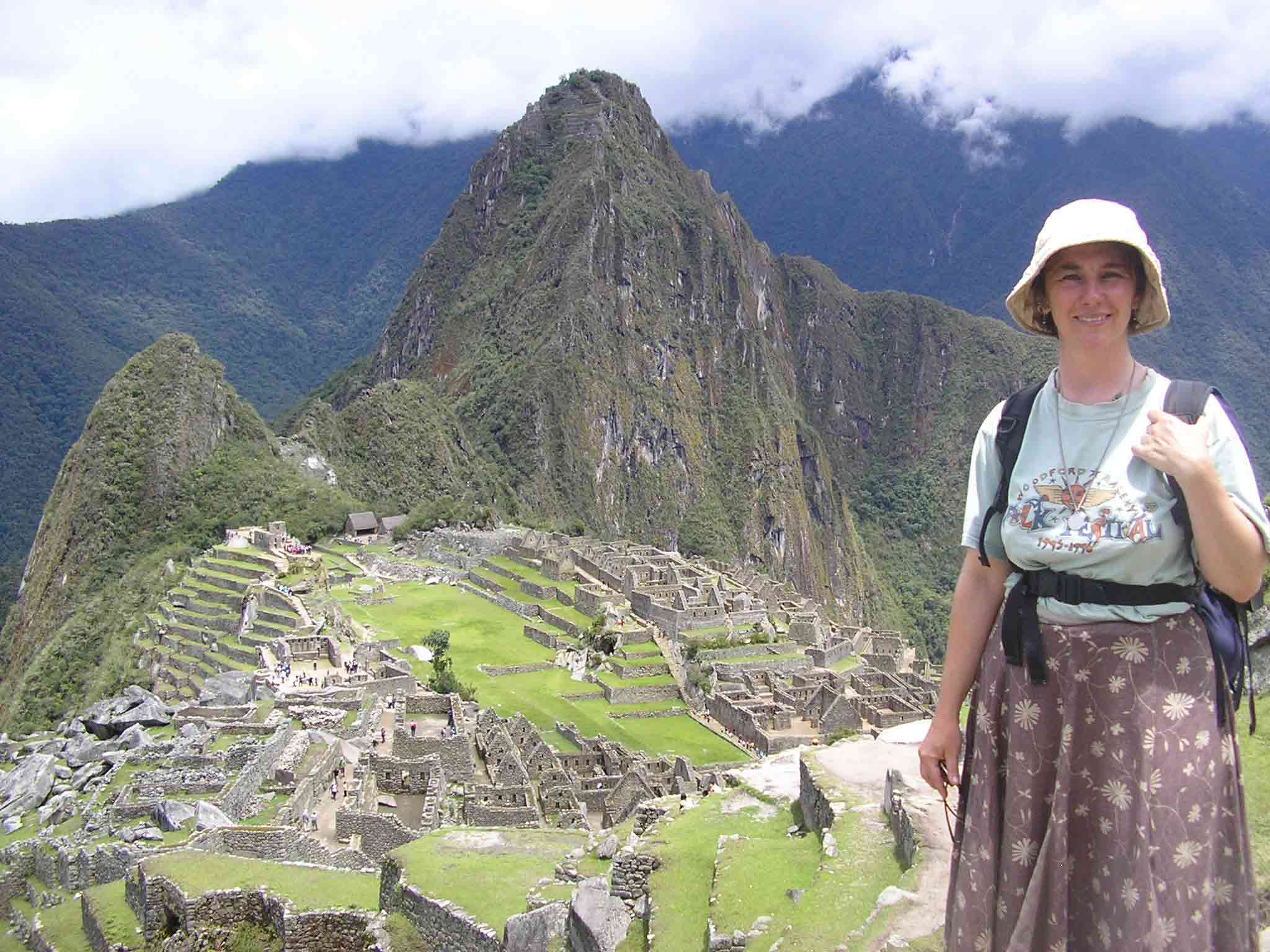
 revealing the ancient city in all its
splendour. One of the girls, Jane was so keen to climb Waynupiccu that she
decided to skip the tour, but the other girl Pardis, was there. The tour was
worthwhile, to hear about the history and purpose of the place. Essentially,
Macchu Piccu is like Peru’s Stonehenge. It was built as an observatory, to
study and track the movement of the sun and the stars, and especially to
pinpoint the solstices and equinoxes, when the sun hits certain stone structures
in certain ways. In historical terms, it’s actually not that old – only
about 550 years. It was built in the 15th Century, and the people who
lived there were priests and priestesses, very high-class people, and their
servants. There were about 400 residents. The city had two zones, the urban
zone, where the houses and temples were, and the agricultural zone, where
terraces were built on the side of the mountain in which to grow food, herbs and
sacred orchids. The residents were all vegetarian, except at the winter solstice
when they would eat sacrificed llamas. There were no children in the city, it
was a celibate religious order. The amount of work that must have gone into
building it is staggering, about 200 terraces, only about 6 feet wide, each one
holding a tiny strip of fertile soil. 1000 workers built it in 50 years. The
place was only inhabited for a few decades and was never completed. It was
abandoned because of the Incan Civil War and a plague of leprosy. The priests
and priestesses fled into the jungle and perished.
revealing the ancient city in all its
splendour. One of the girls, Jane was so keen to climb Waynupiccu that she
decided to skip the tour, but the other girl Pardis, was there. The tour was
worthwhile, to hear about the history and purpose of the place. Essentially,
Macchu Piccu is like Peru’s Stonehenge. It was built as an observatory, to
study and track the movement of the sun and the stars, and especially to
pinpoint the solstices and equinoxes, when the sun hits certain stone structures
in certain ways. In historical terms, it’s actually not that old – only
about 550 years. It was built in the 15th Century, and the people who
lived there were priests and priestesses, very high-class people, and their
servants. There were about 400 residents. The city had two zones, the urban
zone, where the houses and temples were, and the agricultural zone, where
terraces were built on the side of the mountain in which to grow food, herbs and
sacred orchids. The residents were all vegetarian, except at the winter solstice
when they would eat sacrificed llamas. There were no children in the city, it
was a celibate religious order. The amount of work that must have gone into
building it is staggering, about 200 terraces, only about 6 feet wide, each one
holding a tiny strip of fertile soil. 1000 workers built it in 50 years. The
place was only inhabited for a few decades and was never completed. It was
abandoned because of the Incan Civil War and a plague of leprosy. The priests
and priestesses fled into the jungle and perished.
Yesterday morning
I came back out to the village. Margerita and her family were all agog, wanting
to hear about the trip, and I loaded my photos onto my computer and showed them.
They were most impressed. Peruvians hold Macchu Piccu in awe. They see it as the
evidence of the greatness of their past civilisation, before the conquistadors
came and took over their country. The attitude to the Spanish is pretty
ambivalent here. And even though the country is supposedly 90% catholic, I think
there’s some ambivalence to that as well. The boy, Hector, certainly doesn’t
seem to think much of the project to rebuild the church. Certainly the crucifix
outside the church is creepy. It’s very old, and on one side has a carving of
implements of torture. Don’t ask me what’s going on there. 
A
friend of mine from Cuzco kindly made the effort of come out and visit me for
the day, and it was an interesting day for her to visit There was some serious
politics going on all day. A spontaneous meeting of about 25 women around the
edge of a hollow in the ground outside the one of the villages two meagre shops.
They had been talking all day – I’m not sure what about, but I suspect it
was something to do with tourists that come to the town to view the weaving and
coo at the picturesque side of Umasbamba that is presented to them. There had
been a tour out there that day, which I had missed, because I had gone into the
nearby town of Chinchero to meet my friend at the bus stop.
Rafaela held
forth, passionately and at great length. Much of it was in Quechua, and I
couldn’t follow it, but I know it had something to do with me, and another
volunteer who didn't like the village and wouldn't stay and Senorita Mery, the
travel agent who arranges the tours and who brought me out here on my first day.
There seems to be some confusion about the money. The village women seem to be
expecting Senorita Mery to pay them for my accommodation and food, because she
pays them for other things. But I don’t think she’s got anything to do with
it. Certainly it seems that Margarita hasn’t been paid, which she should have
been by now because I paid my fees weeks ago. I think I’ll bring it up with
Eliza when next I go in. I've been told there are bank accounts and the women
are given debit cards with which they can access the money. But there are no
ATM’s in Umasbamba and I don’t think there’s even one in Chinchero. I
think the nearest one is in Cuzco. I’m not at all sure Margarita understands
this system and I’ve not seen the debit card. Margarita has a tendency to
pretend she’s understood when she hasn’t. One of the Maximo staff insisted
that everything had been explained in the past and the women understood, but
it’s clear to me that something’s not right. I managed to get a phone call
happening, ring Eliza and put
her on the phone to Rafaela. Something Rafaela clearly found reassuring, but
I’m not confident that the problem’s been solved.
So, I do the kids
class tonight Rafaela said in the meeting – one bit I did understand,
that there would be at least 8 students at the next two women's classes. That's
good, but I'm feeling the pressure of time. 6 weeks is nowhere near long enough.
15 lessons – I had hoped to achieve more. But it’s only a start and someone
else will have to continue. What this place needs is someone who’s prepared to
come for the long haul. But they would have to be a special kind of person,
someone with no ties, who can handle the sleepy rhythm of village life, and is
content to just settle in and stay for while. Preferably someone with a flair
for languages, and an interest in learning Quechua. The family have been asking
me to stay, saying they don’t want me to go. But what can I do? I have a life
elsewhere, that I very much want to return to. I’ve been on the road long
enough. I want to go home.
I have booked
another tour for this weekend. This time to Lake Titicaca, to see the islands. I
have to go and pack now, because I will be catching the car to Cuzco as soon as
class finishes, and it’s nearly time to go to the school.
Monday 8th December
It’s raining in Umasbamba. The sort of steady, gentle but soaking rain that falls straight down from above. No wind to drive it, but no wind to blow it away, either. It’s December, and the start of the rainy season here. I’ve just gotten back from my weekend trip to Lake Titicaca. I’m so glad I went, it was a fabulous trip, and not very expensive. The trip to Macchu Piccu cost me $215 US dollars, but this one was only $85.
The bus station was crowded and chaotic, and I’m glad he
was there to guide us through it. The ticket-checker nearly ripped the tabs of
both my tickets, the outbound and the return, but I managed to realise what she
was doing and stop her in time. We had the front two seats, which I usually
like, because I like to see out the front, but it can be a little disconcerting
in Peru, as the drivers are all pretty hectic. I managed to sleep a little. It
was a surprisingly good bus, actually, quite new. We arrived in Puno at 4am, and
took a taxi to our hotel, which we had the use of until 7.30. Just enough time
for a nap and a shower, basically, and they served us breakfast there. We were a
bit nonplussed at first, because the hotel was dark, lurking behind bars and
with no doorbell. I kicked at the gate for a good ten seconds and the lights
came on and the concierge came out and let us in, much to my relief. I went
upstairs and flopped into bed.
Puno is the main city on the Peruvian side of Titicaca. 66% of the lake belongs to Peru, the rest to Bolivia. Puno’s pretty plain. Peruvian cities are too poor to be pretty. For example, the buildings are often just raw concrete or brick. There’s no money to paint or render them. Very little land is put aside for things like parks, though there’s usually a few squares, and there tend to be monuments on the tops of the hills. There are no street trees, and even the squares only have a few. Grass is a luxury. Where it exists, it’s fenced off and no one is allowed to sit on it. The thing I really liked about Puno was the motorcycle taxis. They were like tricycles with a motorcycle at the front, and a canopy over two seats at the back.
 The first stop was the Floating Islands. Lake Titicaca is massive – really an
inland sea, and Puno is in a sheltered bay. Puno bay is never deeper than 25
metres, and doesn’t get the heavy weather that the rest of the lake can get,
which is closer to 250 metres in depth. This means that a particular lifestyle
is possible there. The people on the Floating Islands build their islands out of
the root-masses of reeds, lashing the fibrous masses together with rope and
stakes. On top of this, they pile layers and layers of reeds, which they cut
from the same massive reed-beds where they get the root-mass. They put a fresh
layer of reeds down a couple of times a month. Everything is made out of these
reeds. Boats, houses, furniture, beds, the lot. Except the cooking stove, which
is made out of clay. The islands are about one meter thick, and often have a
hole in the middle where they farm fish in nets. Sadly introduced fish like
trout are gradually squeezing out the native species. The islands are usually
anchored to one spot, though the islanders do move them around from time to
time.
The first stop was the Floating Islands. Lake Titicaca is massive – really an
inland sea, and Puno is in a sheltered bay. Puno bay is never deeper than 25
metres, and doesn’t get the heavy weather that the rest of the lake can get,
which is closer to 250 metres in depth. This means that a particular lifestyle
is possible there. The people on the Floating Islands build their islands out of
the root-masses of reeds, lashing the fibrous masses together with rope and
stakes. On top of this, they pile layers and layers of reeds, which they cut
from the same massive reed-beds where they get the root-mass. They put a fresh
layer of reeds down a couple of times a month. Everything is made out of these
reeds. Boats, houses, furniture, beds, the lot. Except the cooking stove, which
is made out of clay. The islands are about one meter thick, and often have a
hole in the middle where they farm fish in nets. Sadly introduced fish like
trout are gradually squeezing out the native species. The islands are usually
anchored to one spot, though the islanders do move them around from time to
time.
We were welcomed onto an island where the local women sang
and danced for us, displayed their handcrafts for sale, and explained, with the
interpretive assistance of Walter, how the islands are made and maintained. They
wore a similar cut of clothing to the women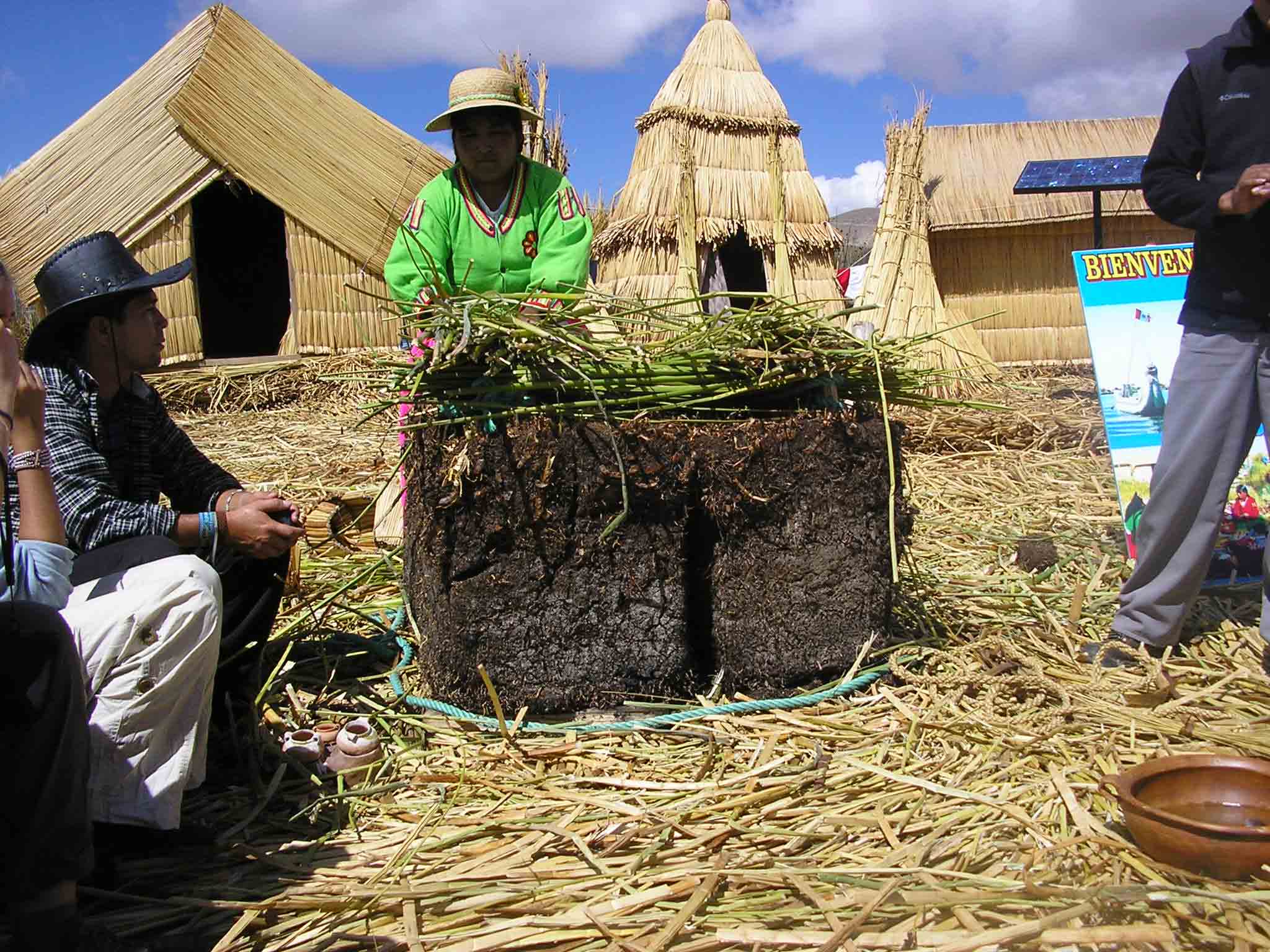 around Umasbamba, but much brighter,
favouring garish lime greens and hot pinks, and with enormous pom-poms hanging
from their braided hair. They must be doing quite well, because they were all
quite plump and sonsy, unlike the weathered and wiry Umasbamba women. A reed
island lasts for about 20 years, and then they abandon it and make a new one. At
one stage, a woman lifted up a plug in the island and dropped a stone tied to a
rope through it to sound the depth of the lake. 18 metres. It did feel quite
strange to walk on, spongy, and not very solid. The people living there are
descended from people who fled the conquistadors and took up residence on the
lake, where they are still relatively unmolested. They pay no tax to the
Government, and are considered to be part of the National Park. Tourism allows
them to educate their children, who are picked up and taken by boat to one of
three schools among the islands in the mornings, and buy things like solar
panels, which they strongly favour. Before solar panels, it was not uncommon for
entire islands to go up in flames due to one carelessly placed candle and many
people had died over the years that way. The women put us in a giant reed canoe,
and paddled us across to a neighbouring island, where we looked around for
awhile, watching the fish farming in process and examining more handcrafts. I
have been chipping away at my Xmas shopping though my trip here, and I bought a
bright wall hanging with pockets to put socks and things in for little Sam here.
around Umasbamba, but much brighter,
favouring garish lime greens and hot pinks, and with enormous pom-poms hanging
from their braided hair. They must be doing quite well, because they were all
quite plump and sonsy, unlike the weathered and wiry Umasbamba women. A reed
island lasts for about 20 years, and then they abandon it and make a new one. At
one stage, a woman lifted up a plug in the island and dropped a stone tied to a
rope through it to sound the depth of the lake. 18 metres. It did feel quite
strange to walk on, spongy, and not very solid. The people living there are
descended from people who fled the conquistadors and took up residence on the
lake, where they are still relatively unmolested. They pay no tax to the
Government, and are considered to be part of the National Park. Tourism allows
them to educate their children, who are picked up and taken by boat to one of
three schools among the islands in the mornings, and buy things like solar
panels, which they strongly favour. Before solar panels, it was not uncommon for
entire islands to go up in flames due to one carelessly placed candle and many
people had died over the years that way. The women put us in a giant reed canoe,
and paddled us across to a neighbouring island, where we looked around for
awhile, watching the fish farming in process and examining more handcrafts. I
have been chipping away at my Xmas shopping though my trip here, and I bought a
bright wall hanging with pockets to put socks and things in for little Sam here.

From there, we set off on a longer journey of a couple of hours. Out of Puno bay
and into the main part of the lake, which was quite choppy. We eventually
arrived on the island of Imantani (I'm not sure I've got the name right), which
was a totally different proposition. Imantani is large, and a real, solid island
of earth and rock. 9 different tribal groups live there. It’s very dry, much
drier than Umasbamba, and there were far fewer domestic animals on it –
probably because there isn’t the grass to feed them. I saw a few sheep and a
couple of donkeys, but that was it. There is no irrigation, and the potato
plants looked shrivelled and stunted, though apparently the rainy season is
about to start there too. The ground was very stony.

 cultivated is, and there are potato
patches clinging to cliffs, on the very edge of the water, and I was stunned to
see one right up on the very top of the mountain. I pity the poor soul who has
to trek all the way up there to tend their crop. Tourism helps bring in extra
money and alleviate a situation that could easily turn to famine. Very little
meat is eaten on the Island. They’re mostly vegetarian, though I assume they
do eat fish. There used to be a fishing industry on Lake Titicaca, but the fish
population has declined probably do to both overfishing and pollution, and the
men no longer work in the fishing industry. Several of them are tour boat
captains instead, working for the companies that bring tourists to their island.
The other industry on the island is weaving, and we passed a gloomy building
full of complicated-looking looms on the way to the soccer ground.
cultivated is, and there are potato
patches clinging to cliffs, on the very edge of the water, and I was stunned to
see one right up on the very top of the mountain. I pity the poor soul who has
to trek all the way up there to tend their crop. Tourism helps bring in extra
money and alleviate a situation that could easily turn to famine. Very little
meat is eaten on the Island. They’re mostly vegetarian, though I assume they
do eat fish. There used to be a fishing industry on Lake Titicaca, but the fish
population has declined probably do to both overfishing and pollution, and the
men no longer work in the fishing industry. Several of them are tour boat
captains instead, working for the companies that bring tourists to their island.
The other industry on the island is weaving, and we passed a gloomy building
full of complicated-looking looms on the way to the soccer ground.

 outside and we were all taken outside to dance
under the stars. After a few dances, we were allowed to sit down and they
performed some traditional dances. One with flags, and another representing the
coming of the Conquistadors. Much
to Sonia’s evident relief, Marlene, Stefani and I opted to go to bed quite
early, and she led us through the moonlit night back to her place. There was no
electricity, we went to bed by candlelight. I slept well in the funny, saggy
bed. It was a very cold night, but there were plenty of blankets. I woke in time
to see the red dawn over Lake Titicaca, the sun rising over the mountains of
neighbouring Bolivia.
outside and we were all taken outside to dance
under the stars. After a few dances, we were allowed to sit down and they
performed some traditional dances. One with flags, and another representing the
coming of the Conquistadors. Much
to Sonia’s evident relief, Marlene, Stefani and I opted to go to bed quite
early, and she led us through the moonlit night back to her place. There was no
electricity, we went to bed by candlelight. I slept well in the funny, saggy
bed. It was a very cold night, but there were plenty of blankets. I woke in time
to see the red dawn over Lake Titicaca, the sun rising over the mountains of
neighbouring Bolivia.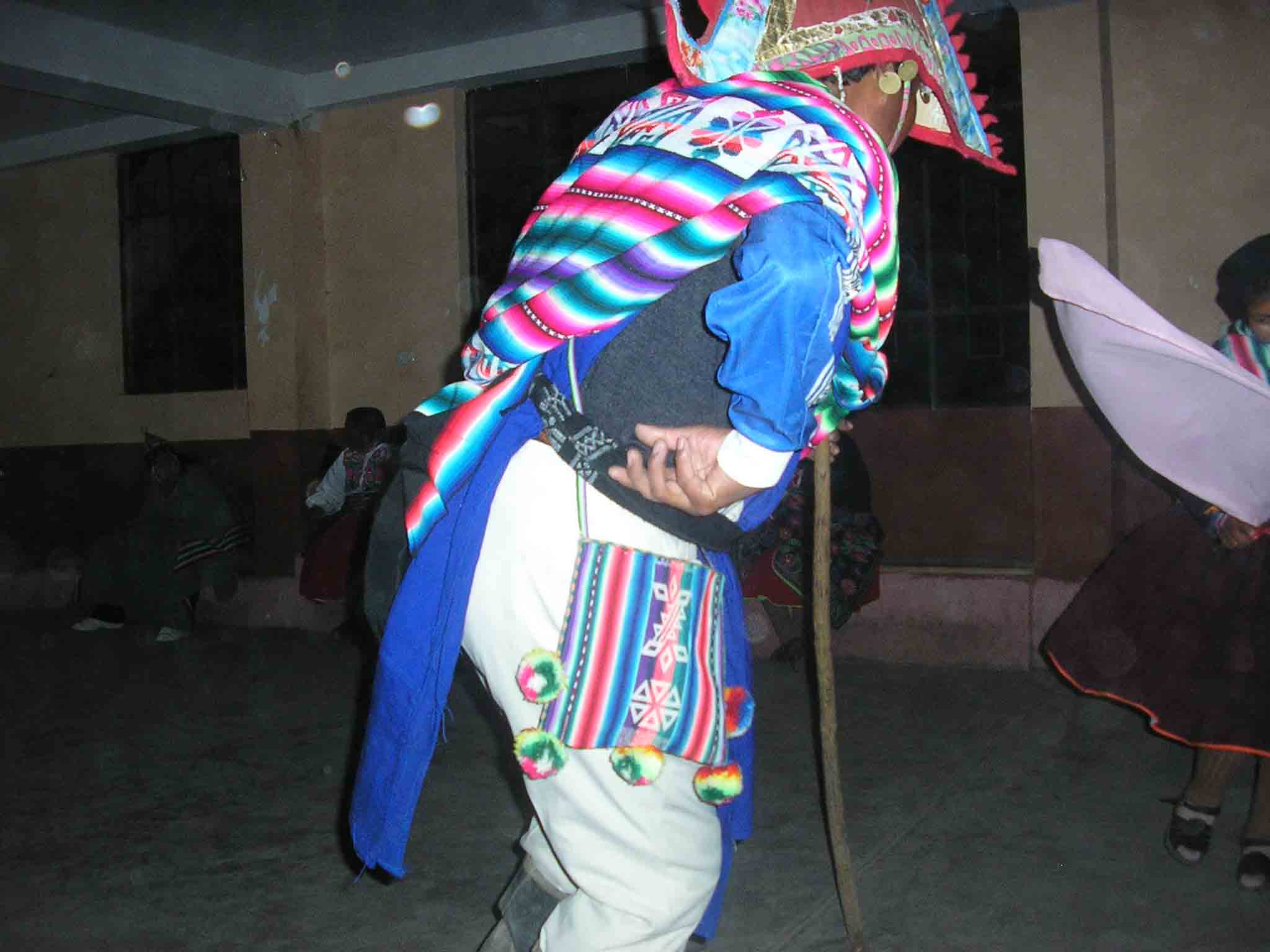
 Walter demonstrated some of the weaving, including the belts the men wear, that
serve as a kind of calendar, each month represented by a symbol that indicates
the kind of work done in that month. I had asked Walter about the lack of
irrigation on the islands. It seems ludicrous that crops should wither in sight
of one of the largest bodies of fresh water in the world. He explained that
there simply isn’t the money to build an irrigation system. It’s something
that successive governments promise, but which just hasn’t been delivered. In
addition, several years ago, when there was a new local government on the island
that received some money it was put to the vote whether to build an irrigation
system or the town hall. The locals voted for the hall. I’m sure there was
more politics to this than meets the eye. Maybe the proposed irrigation system
wouldn’t have benefited everyone equally and the hall was a more egalitarian
option. But nonetheless, the fields remain unirrigated and I’m sure it would
make a huge difference to the productivity of the islands if they could use the
water that’s right there. In addition there is no plumbing at all on this
island. Imantini had a very basic plumbing system – each house had a tap in
the garden, but on Taquali, all water is carried by hand from the one well.
I’m surprised they haven’t worked out some sort of manual system for getting
water to the fields from the lake, even one powered by donkeys – the hillsides
rising from the shores of the lake are very steep. Everything has to be terraced
before it can be cultivated. But not even the closest fields to the banks show
any sign of being watered.
Walter demonstrated some of the weaving, including the belts the men wear, that
serve as a kind of calendar, each month represented by a symbol that indicates
the kind of work done in that month. I had asked Walter about the lack of
irrigation on the islands. It seems ludicrous that crops should wither in sight
of one of the largest bodies of fresh water in the world. He explained that
there simply isn’t the money to build an irrigation system. It’s something
that successive governments promise, but which just hasn’t been delivered. In
addition, several years ago, when there was a new local government on the island
that received some money it was put to the vote whether to build an irrigation
system or the town hall. The locals voted for the hall. I’m sure there was
more politics to this than meets the eye. Maybe the proposed irrigation system
wouldn’t have benefited everyone equally and the hall was a more egalitarian
option. But nonetheless, the fields remain unirrigated and I’m sure it would
make a huge difference to the productivity of the islands if they could use the
water that’s right there. In addition there is no plumbing at all on this
island. Imantini had a very basic plumbing system – each house had a tap in
the garden, but on Taquali, all water is carried by hand from the one well.
I’m surprised they haven’t worked out some sort of manual system for getting
water to the fields from the lake, even one powered by donkeys – the hillsides
rising from the shores of the lake are very steep. Everything has to be terraced
before it can be cultivated. But not even the closest fields to the banks show
any sign of being watered.
Umasbamba, on the other hand, does have irrigation. It’s
very basic and consists of a network of trenches and small aqueducts running
among the fields. Some of these are concrete, other are much older,
painstakingly lined with stones, Still others are just trenches in the earth.
These are managed by a system of blocking or unblocking the various channels
with clods of grass. But Umasbamba has creeks running down from the mountains
for the locals to harness, and no pumping is required. It’s all gravity-fed.
As a result, 2 or 3 different crops a year are possible. Returning to Umasbamba,
after these two trips away, I am aware of how rich it is relatively,in terms of
water, if not mush else.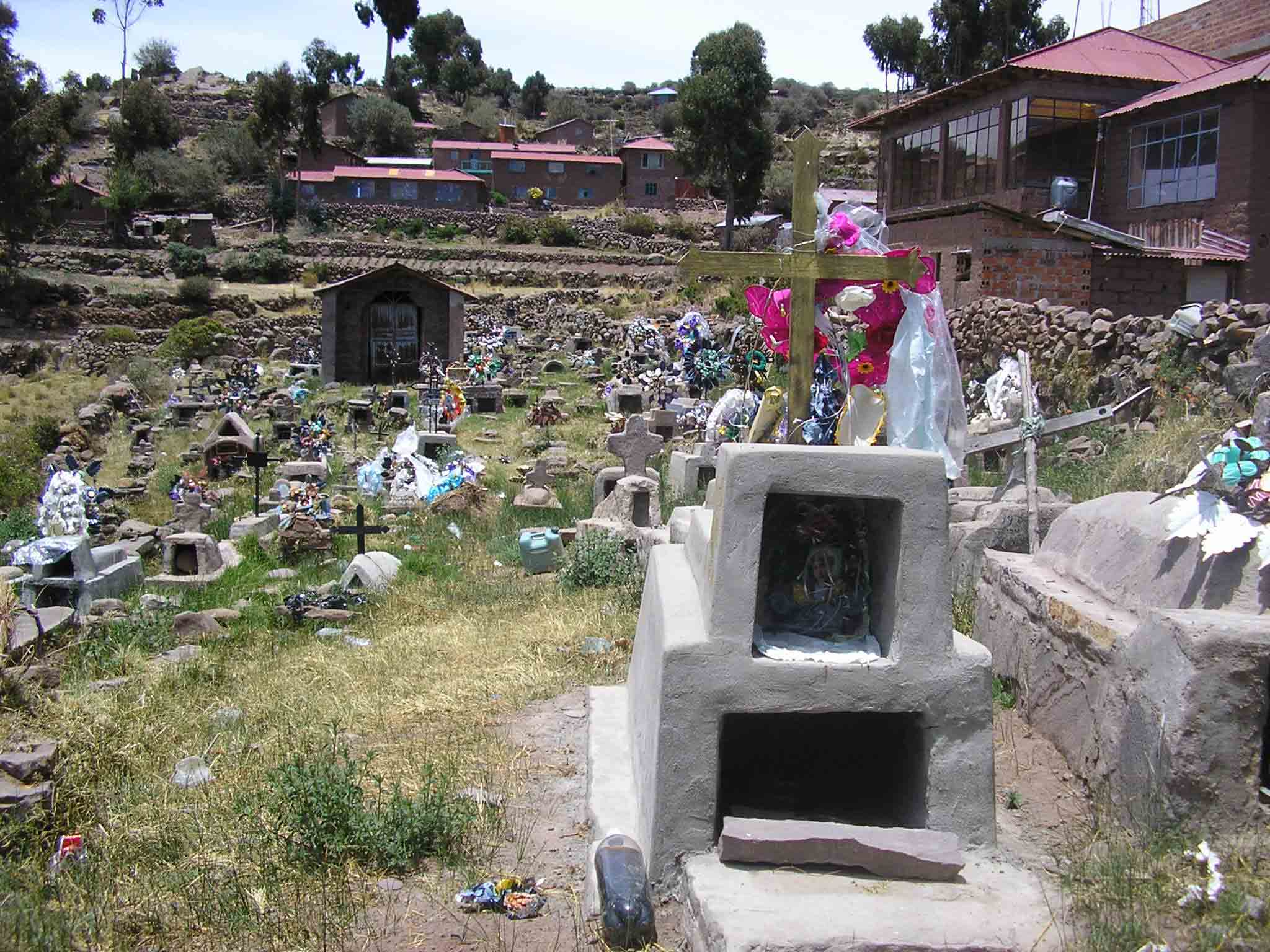
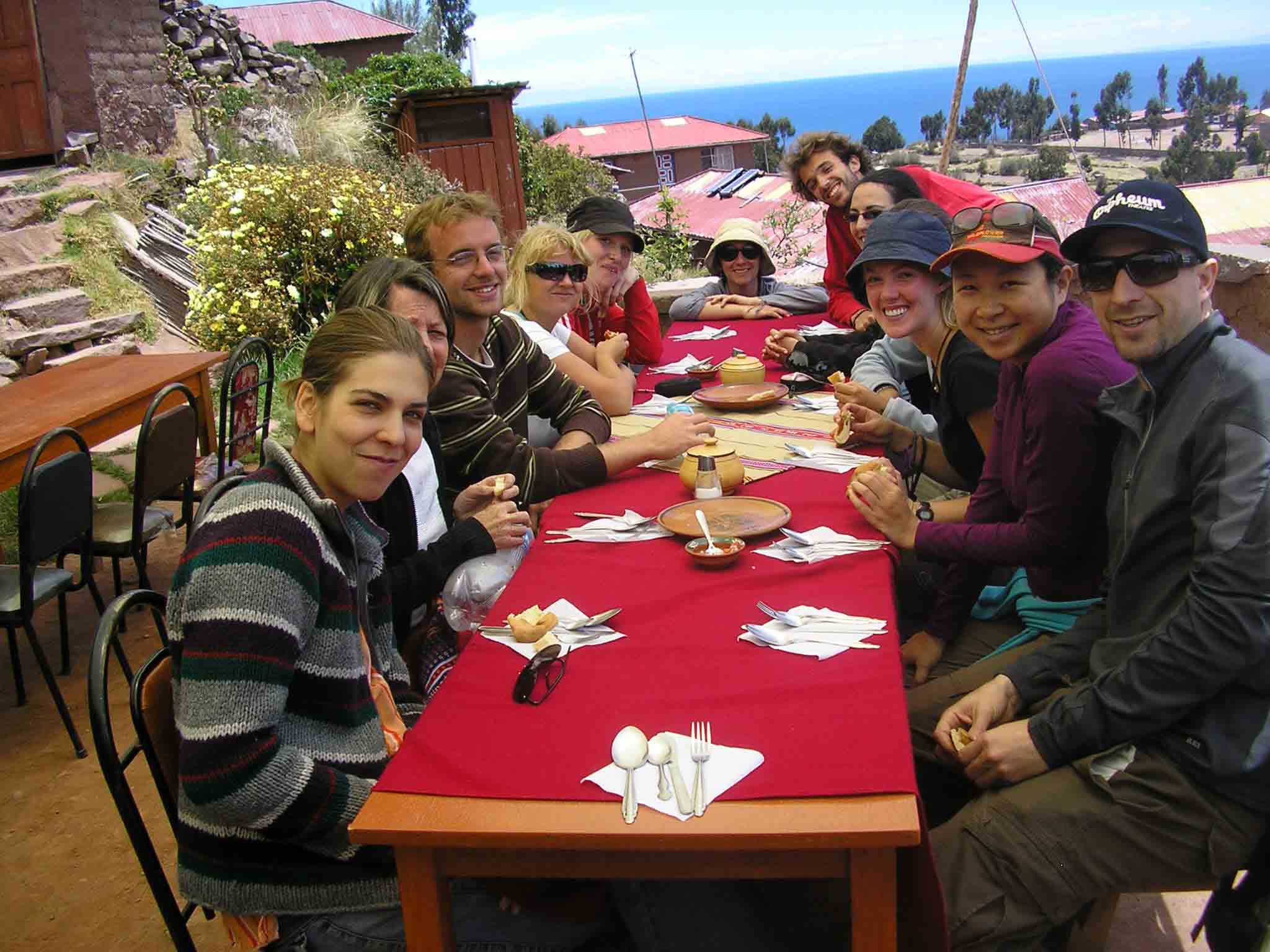 and
we ate a lunch of fried fish and rice. We then walked on – essentially we
walked from one side of the island to the other, and the boat met us on the
other side. I walked with Stefani, Stefani was somewhat concerned for the first
part of the walk about a group of local boys wandering along behind us. I
thought they were ok, but she clearly felt threatened, probably because she was
a bit older and felt vulnerable. I informed Walter of her worries and he walked
with us too. On the second half of the walk, we stopped and browsed a bit at the
various blanket-stalls laid out by the island women, and I bought a few knitted
finger-puppets for little Sam. The end of the walk involved going down 500 stone
steps, and through a series of stone arches. It was a beautiful day. Sunny, and
not too hot. Except for the clouded-over sunset the previous night, we
couldn’t have had better luck with the weather.
and
we ate a lunch of fried fish and rice. We then walked on – essentially we
walked from one side of the island to the other, and the boat met us on the
other side. I walked with Stefani, Stefani was somewhat concerned for the first
part of the walk about a group of local boys wandering along behind us. I
thought they were ok, but she clearly felt threatened, probably because she was
a bit older and felt vulnerable. I informed Walter of her worries and he walked
with us too. On the second half of the walk, we stopped and browsed a bit at the
various blanket-stalls laid out by the island women, and I bought a few knitted
finger-puppets for little Sam. The end of the walk involved going down 500 stone
steps, and through a series of stone arches. It was a beautiful day. Sunny, and
not too hot. Except for the clouded-over sunset the previous night, we
couldn’t have had better luck with the weather.
 The bus back was even more luxurious than the bus there. It
had deeply reclining seats and supports to rest your legs on. This kind of
luxury in Peru really surprised me. I guess we were travelling with the rich
people. The bus I take out here, or halfway here, to Chinchero, where one
changes to a shared taxi is as different as it could be. Old and shabby and very
crowded, belching smoke, with the springs collapsing in the seats and not much
suspension to speak of. My friend Jessie calls it the Chicken Bus, but I’ve
yet to see anyone carrying a chicken. I’m a little disappointed actually. I
expected livestock. But no. Well, one can’t have everything.
The bus back was even more luxurious than the bus there. It
had deeply reclining seats and supports to rest your legs on. This kind of
luxury in Peru really surprised me. I guess we were travelling with the rich
people. The bus I take out here, or halfway here, to Chinchero, where one
changes to a shared taxi is as different as it could be. Old and shabby and very
crowded, belching smoke, with the springs collapsing in the seats and not much
suspension to speak of. My friend Jessie calls it the Chicken Bus, but I’ve
yet to see anyone carrying a chicken. I’m a little disappointed actually. I
expected livestock. But no. Well, one can’t have everything.
Anyway, I slept a few hours on this swanky bus, though it was interrupted by an unexplained police search at a checkpoint, and we got back into Cuzco at about 4am. I took a taxi back to Gloria’s, the house I stay in in Cuzco, and crashed out in a spare bed for a few hours.
In the
morning, Stephanie told me that it was a religious holiday and that Gloria was
planning to attend Mass in the big cathedral in the main square. Apparently she
donated money towards the flowers. Gloria’s very Catholic. After the mass,
they were going to parade the Virgin around the square. We decided to go – as
much to get a chance to see the church as anything else, as they usually charge
tourists to get in. But as it happened we arrived halfway through the Mass
before the one Gloria was planning to attend. The flowers certainly did look
lovely. The place was festooned with pink gladioli and something that looked
like Babies’ Breath. The Virgin, way up on a plinth, wearing gold brocade and
swathed in blue silk, certainly looked impressive. We were keen to see the
inside of this church for a couple of reasons. One was to see the famous Black
Christ. I don’t know why Christ had been depicted with black skin on that
occasion, but the Christ is believed to have wrought a miracle back in the 17th
Century. There was a terrible earthquake in 1650 with many aftershocks and it
was taken outside and carried around the streets for people to pray to. The
sudden cessation of the earthquake is attributed to the miraculous intercession
of this Christ. The other curiosity in this church is the depiction of the Last
Supper with Jesus and his disciples eating Peruvian food – including a plate
of Guinea Pig in pride of place. There is also the incredible original altar,
now hidden behind the current one, which is made of wood and carved with
breathtaking intricacy.
main square. Apparently she
donated money towards the flowers. Gloria’s very Catholic. After the mass,
they were going to parade the Virgin around the square. We decided to go – as
much to get a chance to see the church as anything else, as they usually charge
tourists to get in. But as it happened we arrived halfway through the Mass
before the one Gloria was planning to attend. The flowers certainly did look
lovely. The place was festooned with pink gladioli and something that looked
like Babies’ Breath. The Virgin, way up on a plinth, wearing gold brocade and
swathed in blue silk, certainly looked impressive. We were keen to see the
inside of this church for a couple of reasons. One was to see the famous Black
Christ. I don’t know why Christ had been depicted with black skin on that
occasion, but the Christ is believed to have wrought a miracle back in the 17th
Century. There was a terrible earthquake in 1650 with many aftershocks and it
was taken outside and carried around the streets for people to pray to. The
sudden cessation of the earthquake is attributed to the miraculous intercession
of this Christ. The other curiosity in this church is the depiction of the Last
Supper with Jesus and his disciples eating Peruvian food – including a plate
of Guinea Pig in pride of place. There is also the incredible original altar,
now hidden behind the current one, which is made of wood and carved with
breathtaking intricacy.


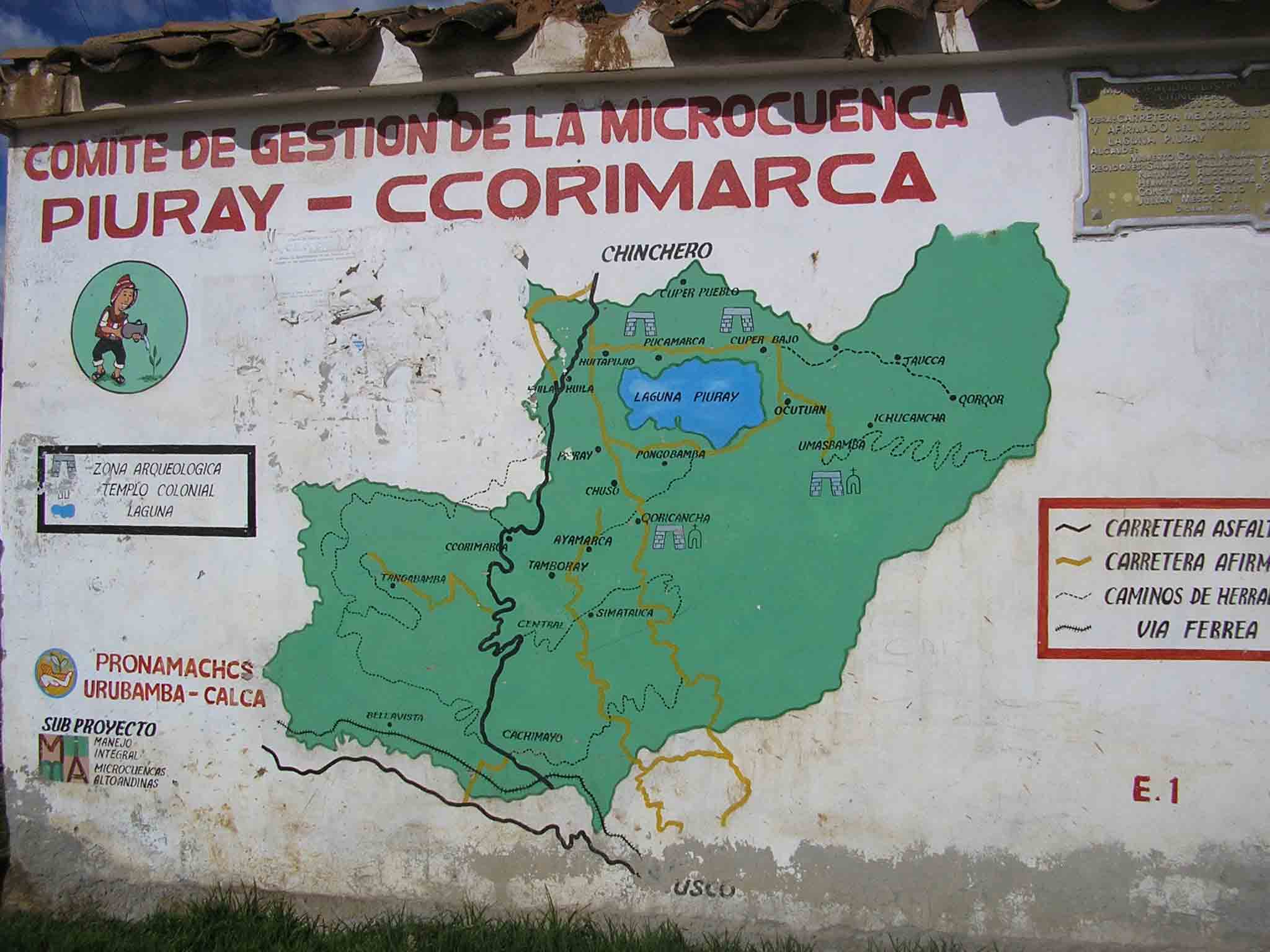

One of the higher-ups from the volunteer organisation
appeared today, with some dude whose name I didn’t catch and who’s job was
unclear to me. I believe he was from a partner organisation. Anyway, he took
photos and asked a lot of questions, writing down the answers in a book. He
wanted to know both the positives and the negatives of the project and
encouraged me to speak openly, which I did. I’m not sure what the woman who
brought him made of it.
I think Umasbamba as a project was in part her idea, and she said it was because
they wanted to offer volunteers a more in-depth experience. There’s something
about her attitude that rubs me up the wrong way – as if we’re just
glorified tourists looking for an authentic experience to enrich our privileged
Western lives, slumming it in the third world because we’re too sophisticated
to just go on an ordinary holiday. The gentleman was Nepali, originally from a
poor village himself, and I cringed when she said she couldn’t wait to
“do” Nepal one day. Unfortunately, some people do approach it like that, and
it irks me. To my mind, the Peruvians are more than just a backdrop for my Big
Experience. They’re real people with real problems, and I came here because I
wanted to contribute something and make some small difference. Certainly, I
don’t think that the Cultural Immersion Project (the official name for my gig
here) should really be marketed that way it has been. This place needs an
English teacher. A real one. Someone who can settle in for while and build
relationships with the kids and make sure they actually learn something.
did. I’m not sure what the woman who
brought him made of it.
I think Umasbamba as a project was in part her idea, and she said it was because
they wanted to offer volunteers a more in-depth experience. There’s something
about her attitude that rubs me up the wrong way – as if we’re just
glorified tourists looking for an authentic experience to enrich our privileged
Western lives, slumming it in the third world because we’re too sophisticated
to just go on an ordinary holiday. The gentleman was Nepali, originally from a
poor village himself, and I cringed when she said she couldn’t wait to
“do” Nepal one day. Unfortunately, some people do approach it like that, and
it irks me. To my mind, the Peruvians are more than just a backdrop for my Big
Experience. They’re real people with real problems, and I came here because I
wanted to contribute something and make some small difference. Certainly, I
don’t think that the Cultural Immersion Project (the official name for my gig
here) should really be marketed that way it has been. This place needs an
English teacher. A real one. Someone who can settle in for while and build
relationships with the kids and make sure they actually learn something.
On my second-last day, I was in the school working on the
kids’ reports, and I had a visitor. Diagonally across from the community
centre (where my classroom is) there’s a kindergarten. I’m usually not there
when it’s open, in the mornings. The kindergarten teacher, seeing the door
open, was curious and came to investigate. He seemed like a very nice young man.
I didn’t catch his name, but he very formally asked me to extend his best Xmas
salutations to my family. Then it was time for me to return to Margarita’s for
lunch and we walked together with all the littlies around us. I said “Hello”
and they said “Hello” back, and then flowed in my wake, chanting “Hello,
hello, hello” all through the village. I felt quite like the Pied Piper.
On my last day, Margarita prepared Cuy (guinea pig)
for me. She also insisted on doing it at lunchtime, which surprised me, I
expected it to happen at night. The cuy was delicious – and happily I was out
when she slaughtered it - but I didn’t understand the import of it being a
lunchtime treat until I got home that night and say Marisol and Hector sitting
glumly by the hutch – which now only contained two cuy. The Guinea pigs
aren’t pets, and much of the time I felt heartily sorry for them, stuck in
their dark bin and not fed that much either. But I guess they are cute. Or maybe
they were just put out because they didn’t get any. Margarita said she was
going to buy more for Xmas. Meat is a rare treat in the village. That was only
the second time in 5 weeks that I ate any.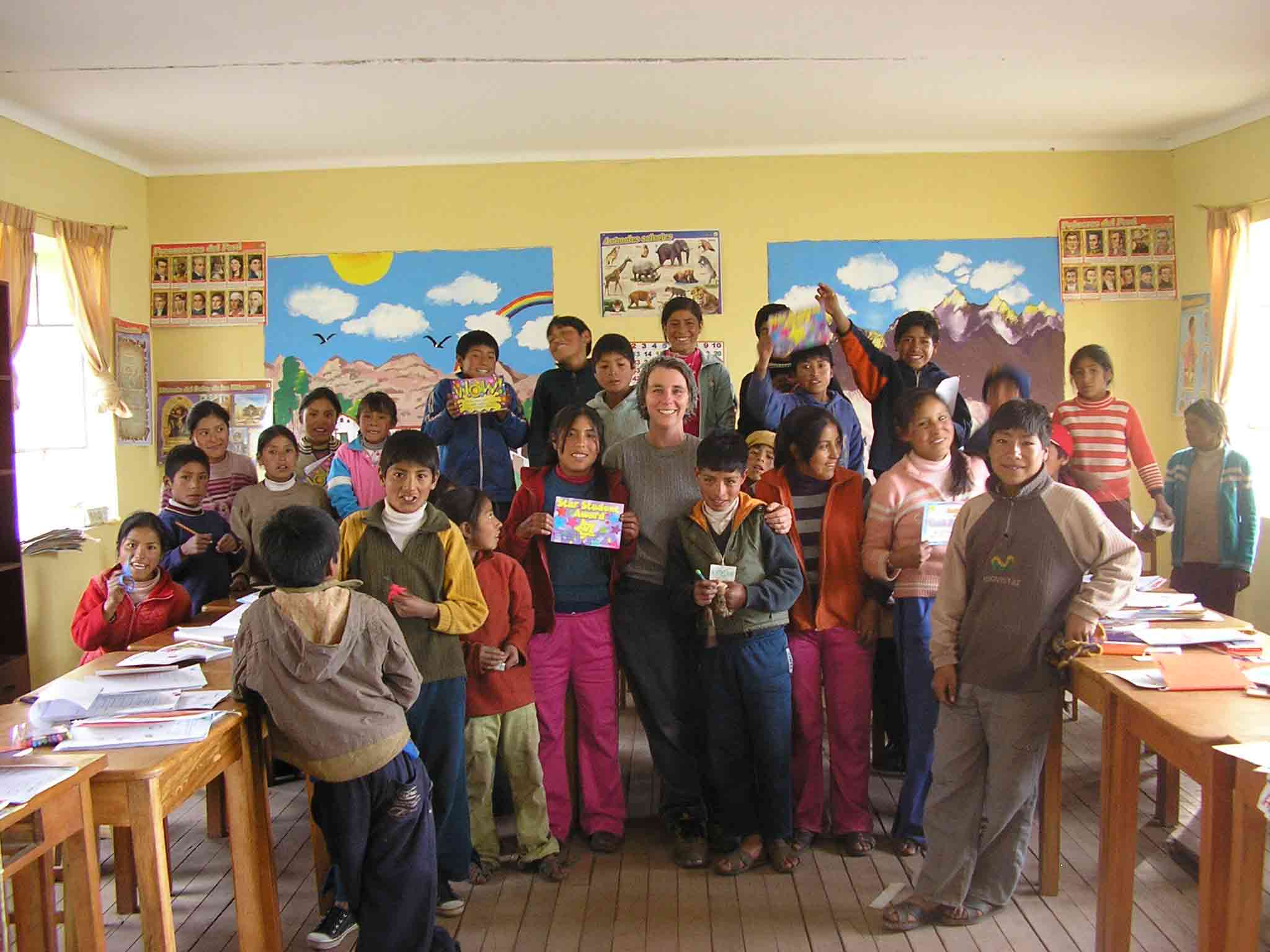
My last kids’ class was followed by a fiesta, or rather,
two fiestas. I had made award certificates for the kids that did well, which
went down well, and distributed small gifts to the rest of the class, and got my
guitar out and sang a song, and then Julio asked me to sit on a chair. To my
surprise, several of them had prepared little performances for me – little
speeches or songs, and one girl recited a very dramatic poem complete with
actions. Julio made a speech about what a big heart I had (though for some
reason he’d gotten it into his hear that I was French and I had to correct him).
Then Julio played the flute while a group of children danced with me, and he
also treated me to his repertoire of impressions and imitations, including a
very impressive monkey and a football commentary. Then they all lined up and
hugged and kissed me, leaving the class with their notebooks and work. While
this was going on, the Amigas were gathering outside.
When the last child had left the room and Julio had taken
his leave, they filed in. This was a much more solemn occasion. They brought out
two bottles of Coke and two glasses – Coke is a luxury, and an indication of
how seriously they took the occasion – and filled my cup, and then the glasses
went round the circle. The first little bit poured on the floor for the Earth
Mother, then each woman toasted me individually, and I returned the toast. Each
woman got a full glass of coke and took her time savouring this luxury, so it
took some time to go right around the room. I sang a few songs while this was
going on. At one point, a man came in, and the circle was interrupted so he
could drink – I don’t think men are expected to wait while women drink, but
then they went back to the circle toast. After all the Coke was gone and all the
women has toasted me, there was some passionate speechifying in Quechua, most of
which I didn’t understand. Margarita held forth and great length, and even got
quite teary, which is unusual, emotions are not displayed freely in the village.
I sang a little more, not knowing what else to do, and then they, too lined up
and each hugged and kissed me, and wished me a happy Xmas and safe travels.
Again and again they asked me when I was coming back, and I was sad to have to
tell them I didn’t know. I don't know if I’ll ever go back, but I hope
someone else will go.
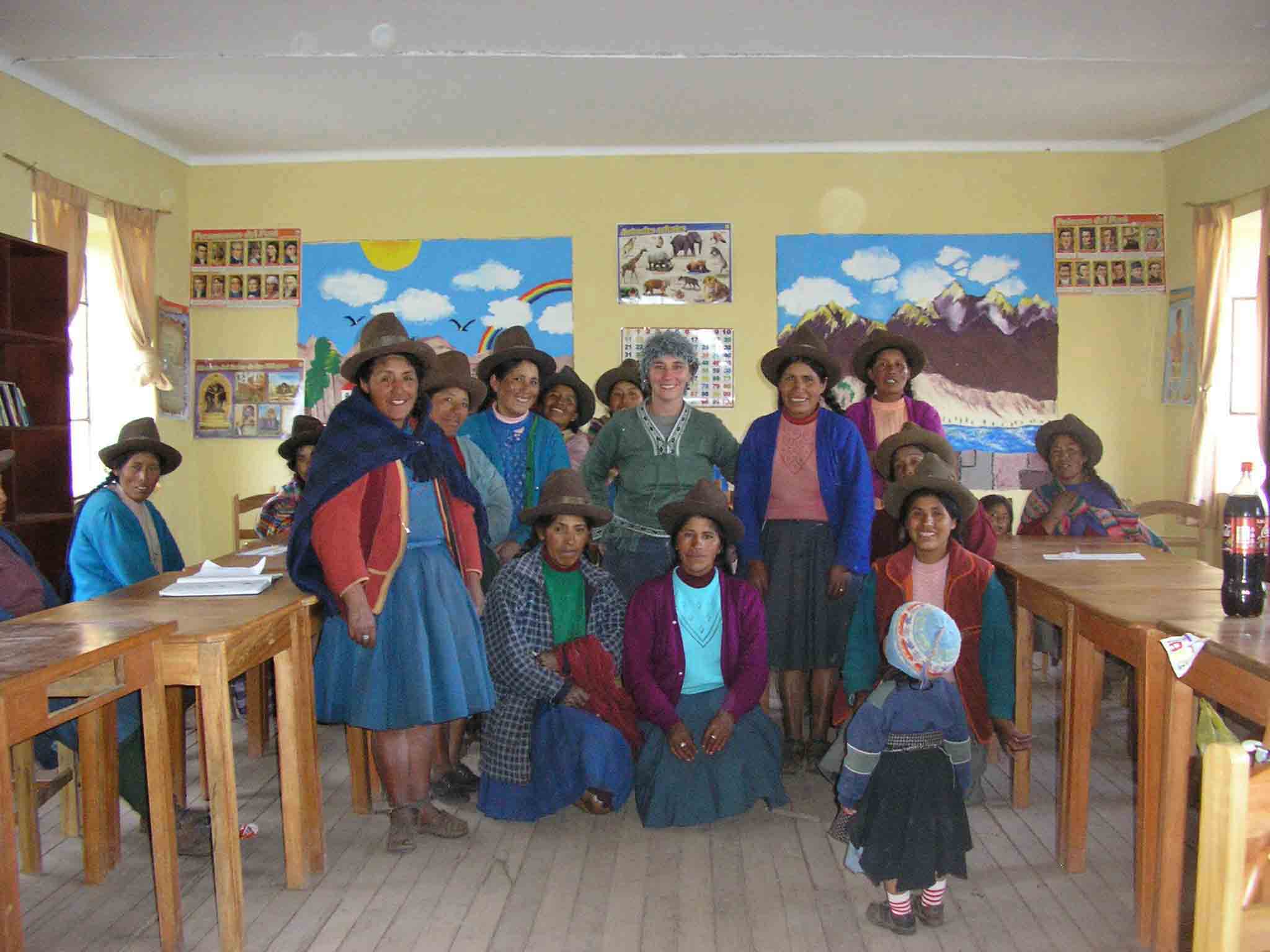
I woke early, and shot off to the school again to tidy up
and put some finishing touches on the stocktake I did for the next teacher. Then
Margarita, Marisol, Hector and I went out to take photos. For some reason,
Domingo didn’t come. I expected him to, but he excused himself and went to
work on the church. He said goodbye somewhat gruffly. The Umasbambans aren’t
good with emotional moments, and permanent goodbyes are always awkward in any
culture. I took photos of them out in the flowering potato fields – it seemed
important for them for me to do this, and then I went back to the house to get
my bags. The only problem was – no taxis. Usually one turns up every half an
hour or an hour and Saturday mornings have usually been the busiest time because
it’s when the locals are most likely to go to Cuzco, but all morning I
hadn’t seen one and was starting to get worried in case the road had been
blocked somehow. I hugged and kissed Margarita and Marisol goodbye, and Hector
helped me down to the road with my bags. A very old woman called out to me as
wee walked “Ciao Mamacita!” (goodbye little mother) as we walked. The older
women often referred to me as “Mama” or “Mamacita” while the younger
ones called me “Senorita”, or sometimes more simply “Amiga” (female
friend). They referred to themselves collectively and to my English class with
them as “Las Amigas” (the women friends).
Hector said we should walk the mile or so down to the lake, because there would be more cars there because of a fork in the road leading to other villages and that we did. The wheely suitcase took a pounding on the rough road, and Hector actually carried it on his shoulders for a long way – tough little thing he is. Then finally, a taxi came into view, much to my relief, and I was off to Chinchero. Like his father, Hector was gruff about the goodbye, and I was sad to say goodbye to him – he’s a nice kid. Much mellower and gentler than most of the village boys.
An hour later and a particularly hair-raising taxi ride
from Chinchero, I was back in Cuzco, and damn happy, about it too. Walking my
usual route from the taxi depot to Maximo, I stumbled into a small informal
market I’d never come across before. I’ve been used to seeing women with
wheelbarrows of tomatoes and onions and stuff like that, but here people were
just standing around with sacks on the corner of Avenida El Grau and the
Santaigo highway. Standing so close together I could barely get through with my
luggage. Glancing into the sacks, I saw that they were full of live guinea pigs
– being sold just in time to be fattened for the Xmas and New Year
celebrations, I guess (as native Peruvians only eat cuy on the major holidays.)
Some of the sacks had live chickens in them. Maybe I’m going to miss the
Chicken Bus when it comes into it’s own, I thought. Gloria welcomed me and
plied me with a wonderful lunch, and I revelled in a hot shower and then went
shopping with my friend Stephanie, who was still in Cuzco after all because her
trip to Macchu Piccu had been delayed.
I was right about the report for Maximo Nivel. Eliza and Carlene were most impressed and I was able to talk to them about my concerns and about what sort of people should be sent to Umasbamba in the future. I’m concerned about the promotion of the Cultural Immersion Project attracting the wrong sort of person, making it all sound more glossy and romantic than it is. The truth is, that Umasbamba’s a tough call for a Westerner, it’s lonely and hard work, and lot of the time, it’s quite boring. They’d be better to be honest about that and send people who are passionate about making a difference. Personally, I think a husband and wife team would be ideal. They could support each other and the woman could teach the Amigas and the man the men. The men often said they wanted lessons, but hung back from coming. I think they felt uncomfortable with a woman teacher. Eliza and Carlene seemed very pleased with what I’d done, and I told them that future volunteers were welcome to contact me for information and advice. So I was quite happy with that in the end.
 Stephanie and I had a pretty serious shopping spree. First we went in search of
the shops that sell sandals made out of recycled tyres that the village women
wear. It took a long time to find them, and we ended up going through a whole
market section of Cuzco where no westerners ever go, only Peruvians. Some of it
was the meat market – no refrigeration. I’ve passed shops where they
slaughter chickens on the sidewalk before, but this was macabre. Lots of heads
and feet, often being sold as sets, out on benches in the street. And large and
strange looking fish in various stages of dissection. Having finally found the
shop and managed to find a pair big enough (Peruvian women are a lot smaller,
and so are their feet) I paid the handsome sum of 7 soles ($3.50) for my sandals
and we went on to the larger San Pedro market. Here I bought some frilly
petticoats to go with my traditional skirt, some Peruvian silver earrings for
about $1 each, and a knitted devil mask for Ben for Xmas. We wandered through a
number of shops, and I came across a jeweller and fell in love with a ring
he’d made, which I bought, and Stephanie bought a Madonna figurine as a
farewell gift for Gloria, because she’s dropped her one and broken it. This
involved going into a whole series of religious shops which was quite
interesting. The Peruvuians favour a depiction of the Madonna which I have
irreverently come to call the Squirting Virgin, because it shows her about to
breastfeed the Christ child with milk dripping out of her breast. The
iconography is elaborate and quite beautiful, and I thought of inquiring into
the cost of one, but assumed they would be out of my budget. Stephanie took me
to a gallery that featured the work of a Cuzcenean artist who specialised in such iconography. His sculptures
all had bizzarely elongated necks but were quite beautiful.
Stephanie and I had a pretty serious shopping spree. First we went in search of
the shops that sell sandals made out of recycled tyres that the village women
wear. It took a long time to find them, and we ended up going through a whole
market section of Cuzco where no westerners ever go, only Peruvians. Some of it
was the meat market – no refrigeration. I’ve passed shops where they
slaughter chickens on the sidewalk before, but this was macabre. Lots of heads
and feet, often being sold as sets, out on benches in the street. And large and
strange looking fish in various stages of dissection. Having finally found the
shop and managed to find a pair big enough (Peruvian women are a lot smaller,
and so are their feet) I paid the handsome sum of 7 soles ($3.50) for my sandals
and we went on to the larger San Pedro market. Here I bought some frilly
petticoats to go with my traditional skirt, some Peruvian silver earrings for
about $1 each, and a knitted devil mask for Ben for Xmas. We wandered through a
number of shops, and I came across a jeweller and fell in love with a ring
he’d made, which I bought, and Stephanie bought a Madonna figurine as a
farewell gift for Gloria, because she’s dropped her one and broken it. This
involved going into a whole series of religious shops which was quite
interesting. The Peruvuians favour a depiction of the Madonna which I have
irreverently come to call the Squirting Virgin, because it shows her about to
breastfeed the Christ child with milk dripping out of her breast. The
iconography is elaborate and quite beautiful, and I thought of inquiring into
the cost of one, but assumed they would be out of my budget. Stephanie took me
to a gallery that featured the work of a Cuzcenean artist who specialised in such iconography. His sculptures
all had bizzarely elongated necks but were quite beautiful.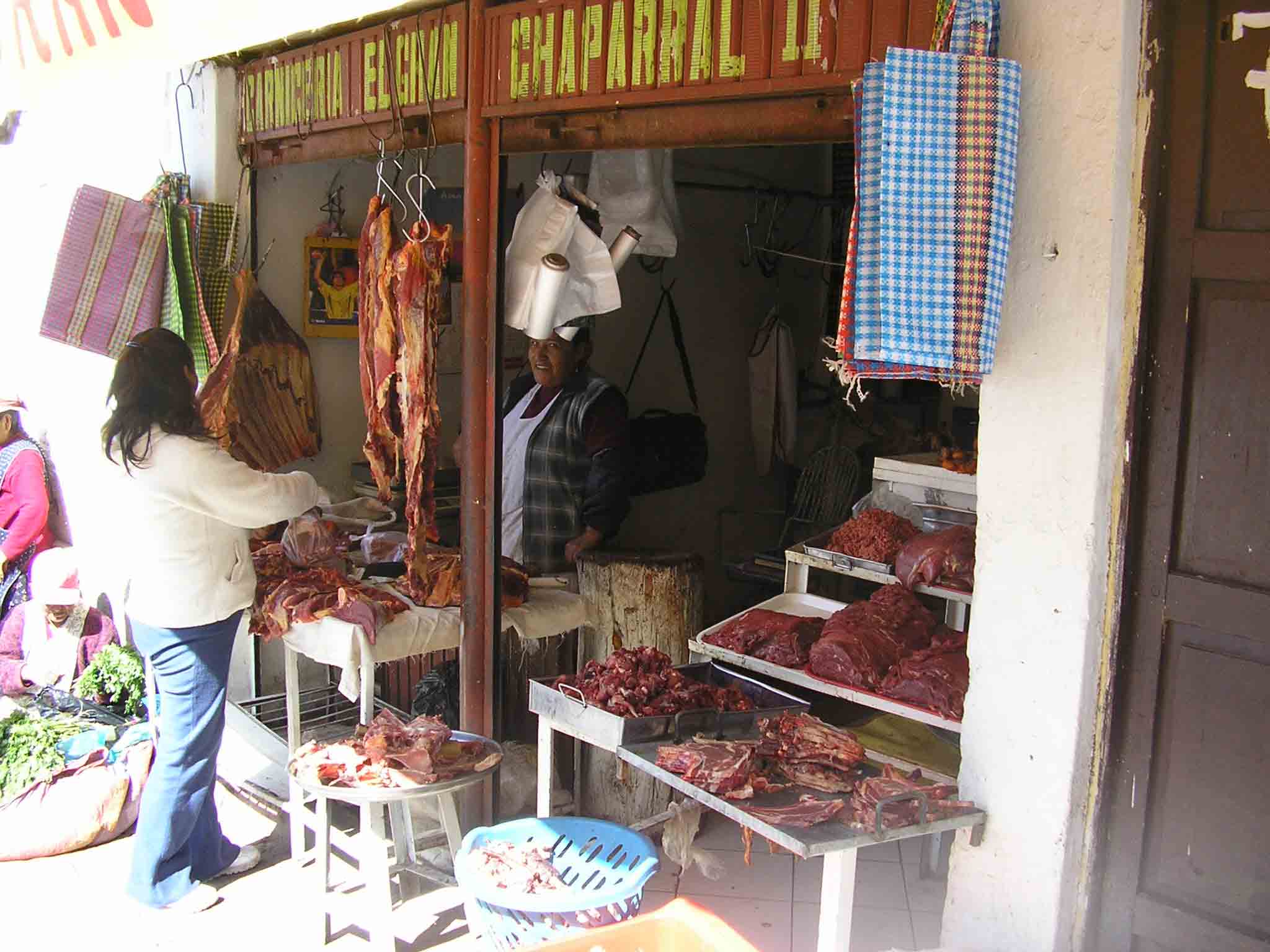


Sunday I woke very early, eager for the afternoon to come and my plane. Stephanie left early, on her way to walk the Inca Trail to Machu Piccu, and I got up to hug her goodbye. I decided to take one last look around the city, and finally take one one or two on the museums which I just hadn’t made it to, and did a little more shopping. I’d left my luggage at Maximo and went in and repacked everything, then went for a walk around the town. There was a parade going on in the Square, similar to one I’d seen a few weeks ago, with all these different groups – schools, military personnel, brass bands, Government workers – marching across the square under the watchful gaze of dignitaries who seemed to be in Army uniform. The first museum I went to was sadly shut, but the second, The Museum of Precolumbian Art, was open and well worth the visits. Then I poked around in the shops, buying myself a couple of treats and using up my leftover Peruvian soles, before heading back to Maximo to get my bags and getting a taxi to the airport. The taxi the porter at Maximo hailed for me was the most ramshackle one yet, and the ride was particularly hair-raising. It was almost like Cuzco had to take a parting shot at me, just to remind me who was boss.
And now I’m in LA, where I’ve been killing time for 14
hours waiting for my connecting flight. I hasn’t been too bad. Compared to the
3rd world, LA airport is pretty mellow, and I was able to find a
quiet corner and have a snooze. Now all I have to do is weather the 17-hour
flight to Melbourne, and I’m home.
Love, Penelope.